The Hidden Hazard on Every Site: Why Li-Ion Battery Safety Can No Longer Be Ignored
Walk onto any modern construction site, warehouse, or commercial facility today, and you will find it powered almost entirely by lithium-ion (Li-ion) batteries. From the 18V power tools wielded by tradespeople to the radios, laptops, and mobile phones sitting in the site office, the reliance on cordless power is total. However, this convenience has introduced a severe, volatile, and heavily misunderstood hazard into the workplace.
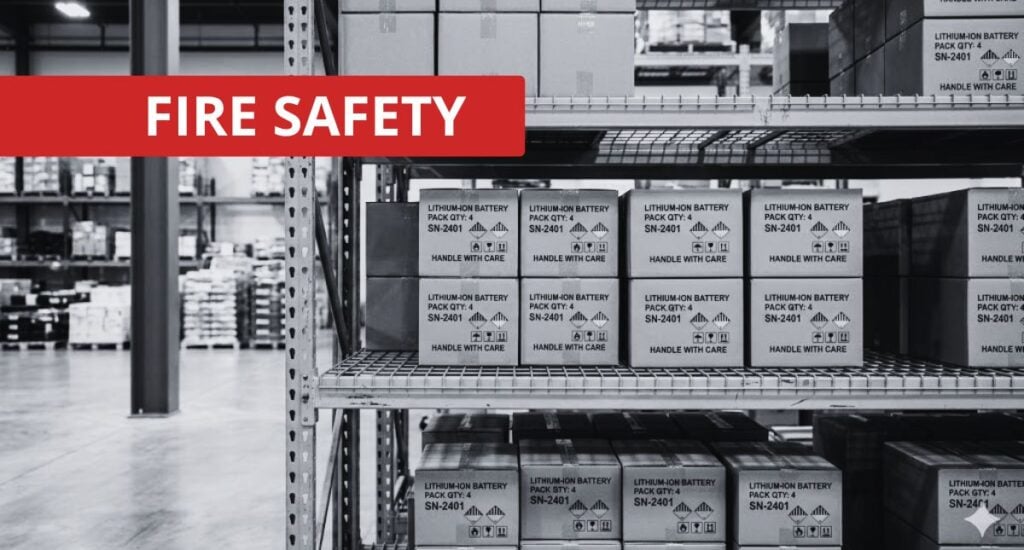
The data is alarming. Recent 2026 research from global insurer QBE, gathered via FOI requests to UK fire brigades, reveals that fire and rescue services are now tackling a lithium-ion battery fire every five hours—equivalent to nearly five fires every single day. Furthermore, incidents involving Li-ion batteries have risen 147% over the last three years alone, with 23% of these fires occurring specifically in commercial premises.
Despite the frequency of these incidents, a staggering number of sites remain unprepared. A survey conducted by the British Safety Council revealed that 54% of UK businesses have experienced an incident involving a lithium-ion battery (from overheating to full explosions), yet 71% had not updated their fire risk assessments to account for them. Li-ion safety is no longer a peripheral issue; it is a critical threat to site safety, assets, and operational continuity.
What is a Class L Fire? Understanding the New BS ISO 3941:2026 Classification
For decades, fire safety professionals and site managers categorised fires based on traditional fuel sources—Class A for combustibles like wood, Class B for flammable liquids, and so on. But as Li-ion battery fires became more prevalent, it became glaringly obvious that they did not behave like standard electrical or chemical fires.
In response to this growing crisis, the British Standards Institution (BSI) published BS ISO 3941:2026, officially introducing “Class L” as a dedicated fire classification. This specific classification covers fires involving lithium-ion cells and battery packs. It was introduced because regulatory bodies finally recognised the distinct, highly dangerous electrochemical hazard these batteries present when they fail.
It is crucial to understand that a Class L fire is not just an “electrical fire.” While the battery stores electrical energy, the fire itself is a violent chemical reaction. The formal recognition of Class L signals to Health & Safety managers, insurers, and site operators that traditional fire mitigation strategies are no longer sufficient to address this modern risk.
Thermal Runaway Explained: Why Li-Ion Fires Are Fundamentally Different
To understand why Class L fires require specialized storage and charging equipment, you have to understand the science of battery failure. When a Li-ion battery is damaged—whether through physical impact on site, overcharging, or exposure to extreme heat—it can enter a state known as thermal runaway.
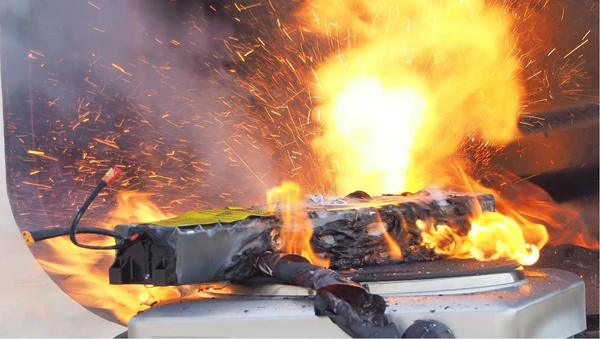
Thermal runaway is a rapid, self-sustaining chemical reaction inside the battery cell. Once it begins, it cannot be easily stopped. The process generates extreme heat, often exceeding 600°C in seconds, causing the failure to cascade from one cell to the next.
This process causes several deadly phenomena:
Self-Oxygenation: Unlike normal fires, thermal runaway creates its own oxygen, meaning it does not need atmospheric air to burn.
Toxic Gas Release: The battery forcefully vents highly toxic and flammable gases, including hydrogen and carbon monoxide.
Explosive Force: If these vented gases are constrained, or if the internal pressure builds too rapidly, the battery can violently explode, expelling burning shrapnel across the site.
Why Traditional Fire Extinguishers and Standard Cabinets Fail Against Class L Fires
Because a Class L fire is a self-oxygenating chemical reaction, standard fire safety equipment is fundamentally ill-equipped to handle it. If a power tool battery ignites inside a standard, thin-walled metal site locker, the locker essentially becomes an oven. It will warp, melt, and allow the extreme heat and toxic gases to spread directly into the room.
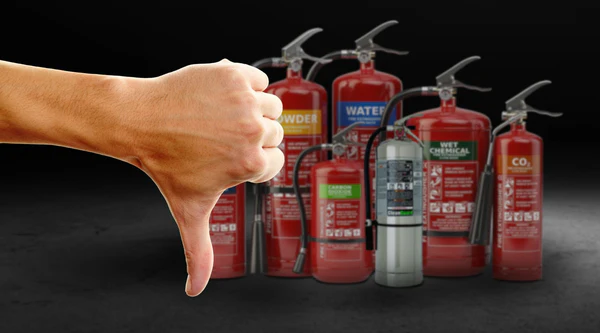
Similarly, traditional Class A (water) or standard dry powder fire extinguishers will struggle to suppress the blaze. While copious amounts of water can eventually cool a battery, standard extinguishers do not remove the heat fast enough to stop the chemical reaction.
Furthermore, Li-ion batteries possess a notorious re-ignition risk. Even after a fire appears to be completely extinguished, “stranded electrical energy” inside the undamaged cells can cause the battery to spontaneously reignite hours, or even days, later. This is why specialized physical containment is the only reliable first line of defense.
Updating Your Fire Risk Assessment (FRA) for Class L Hazards
Under the Regulatory Reform (Fire Safety) Order 2005, every site is legally required to maintain a comprehensive and up-to-date Fire Risk Assessment (FRA). With the official introduction of the Class L fire rating via BS ISO 3941:2026, failing to explicitly address lithium-ion battery hazards is a massive compliance oversight.
If your site charges heavy-duty power tools, operates a fleet of e-bikes, or has banks of laptops charging overnight in a temporary site cabin, your FRA must reflect this.
You must now evaluate:
Battery Storage Density: How many batteries are charging in a single location?
Proximity to Escape Routes: Are charging stations blocking main exits?
Containment: What physical barriers are in place to stop thermal runaway from spreading to the wider building?
The Insurance Threat: The Financial and Operational Costs of a Site Fire
Beyond the immediate threat to human life, Class L fires represent a massive financial vulnerability. Insurance companies are acutely aware of the rising statistics, and they are cracking down on poor battery charging practices. If a site fire occurs and the subsequent investigation reveals that batteries were charged haphazardly—such as daisy-chained extension leads on combustible wooden desks—your insurance claim is highly likely to be voided.
Consider the comparison:
Scenario A: A 5Ah power tool battery enters thermal runaway inside a specialized, fire-rated charging cabinet. The cabinet contains the blast, suppresses the fire, and only the locker and the battery are lost. Downtime is minimal.
Scenario B: The same battery ignites while charging on a workbench overnight. The fire spreads to the site cabin, destroying critical site plans, expensive equipment, and halting work on the entire project for weeks. The financial loss runs into the hundreds of thousands.
Investing in compliant charging equipment is not just an H&S box-ticking exercise; it is an essential insurance policy for your business.
Best Practices for Safe Battery Charging: Segregation, Ventilation, and Containment
To mitigate the risk of Class L fires, site managers must implement strict, non-negotiable rules for how batteries are handled and charged. Reliance on the “common sense” of workers is not a viable strategy; physical controls and clear protocols must be established.
Core Best Practices Include:
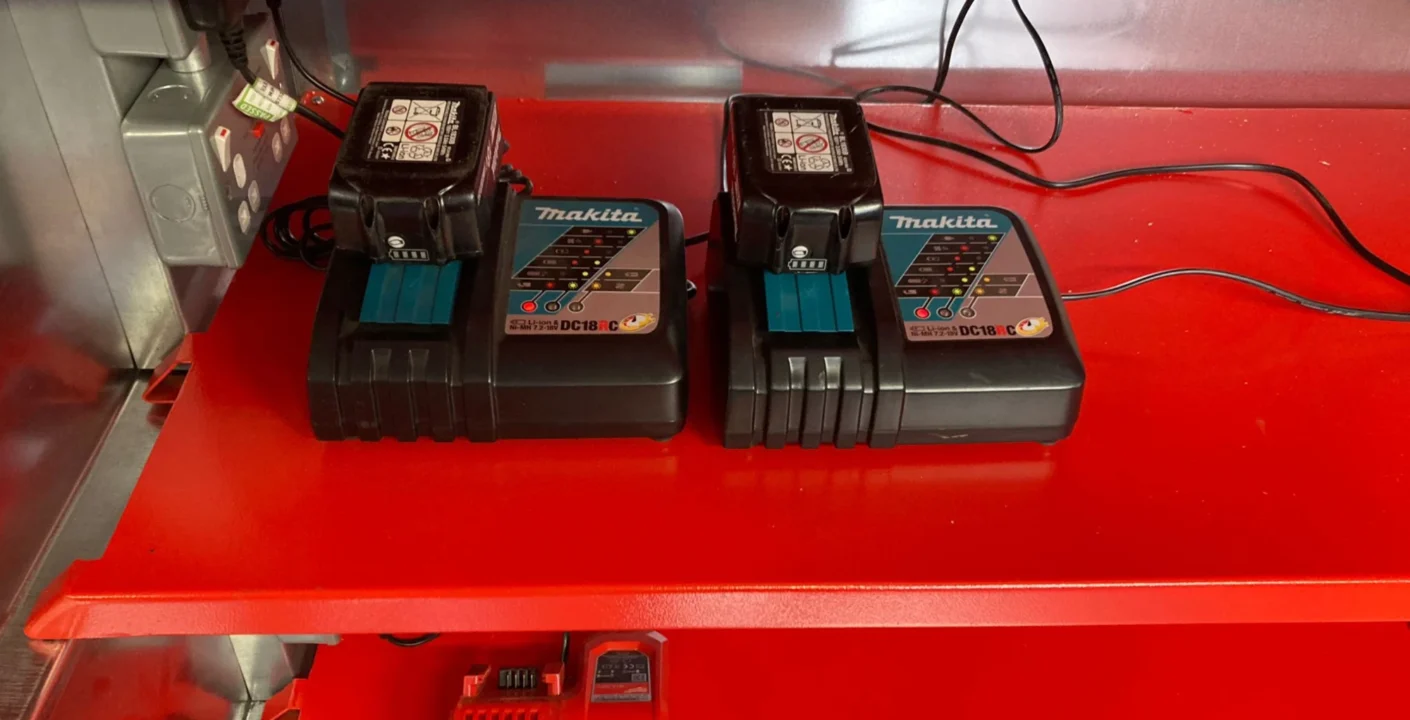
Never Daisy-Chain Leads: Plugging extension leads into other extension leads to charge multiple devices overloads circuits and causes overheating. Use dedicated charging lockers with built-in, isolated sockets.
Segregation: Keep charging stations away from combustible materials, timber stores, and highly trafficked escape routes.
Ventilation and Temperature Control: Batteries should be charged in dry, well-ventilated areas to disperse heat. Never charge batteries in direct, intense sunlight or freezing conditions, as temperature extremes damage cell integrity.
Don't Forget the Office: The Risk of Laptops, Tablets, and Mobile Phones
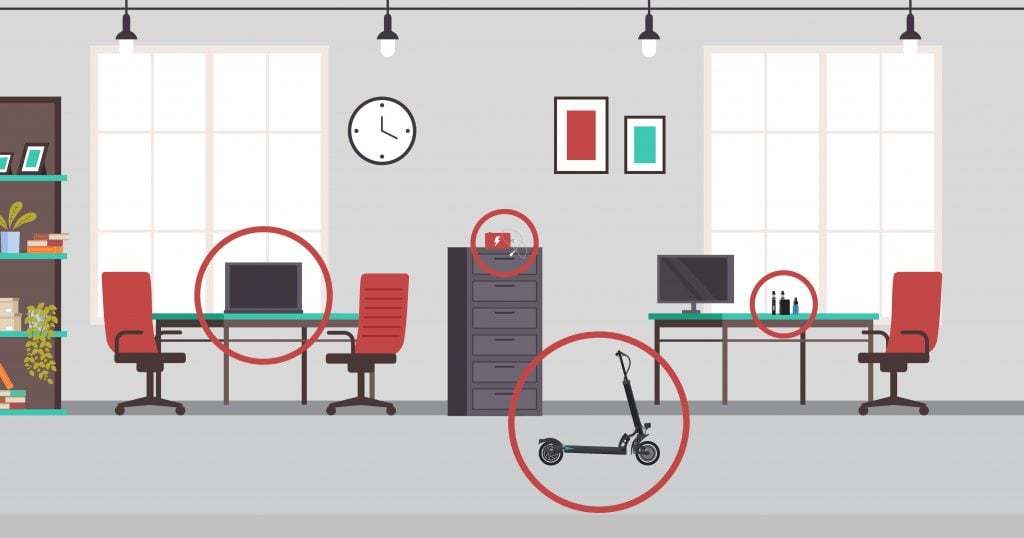
When we think of site safety, we naturally picture heavy machinery, 18V grinders, and massive drill batteries. However, it is a dangerous mistake to ignore the site office. Site managers, architects, and administrative staff rely heavily on laptops, tablets, and mobile phones, all of which contain Li-ion batteries.
A swollen laptop battery left plugged in over the weekend, or a cheap, uncertified mobile phone charger bought online, presents the exact same Class L fire risk as a power tool battery. In fact, because office environments contain high amounts of Class A combustibles (paper, desks, soft furnishings), a thermal runaway event here can spread disastrously fast. Securing administrative devices in properly ventilated, surge-protected charging trolleys or lockers is just as vital as securing power tools.
Indoor vs. Outdoor Storage: Assessing Your Site's Unique Charging Needs
When selecting Class L safety equipment, the first decision H&S managers must make is whether to locate their charging hubs indoors or outdoors. Both approaches are valid, but they serve different site layouts and risk profiles.
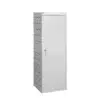
Outdoor Storage (Isolation): If your site has the external space, moving high-volume battery charging completely out of the main facility is the safest approach. By isolating the hazard outdoors in a secure, weather-proof, and fire-resistant unit, you remove the risk from your personnel and most valuable assets entirely.
Indoor Storage (Compartmentalization): If outdoor space is unavailable or impractical due to theft risks in urban areas, indoor charging must rely heavily on compartmentalization. Instead of charging dozens of batteries on open shelves, they must be separated into individual, fire-rated lockers. If one battery fails, the steel compartmentalization prevents the thermal runaway from leaping to adjacent batteries, starving the fire of collateral fuel.
The Role of Built-In Fire Suppression Technology
For high-risk environments, physical steel is sometimes not enough. This is where active fire suppression technology steps in to stop a Class L fire before it fully develops.
Advanced battery charging lockers are now available with built-in suppression systems that activate automatically. When the internal temperature of a locker compartment reaches a critical threshold—indicating thermal runaway has begun—the system deploys a specialized cooling agent directly onto the battery. This localized suppression acts immediately, rapidly cooling the cells and suffocating the chemical reaction before toxic smoke can overwhelm the room. It is the ultimate fail-safe for indoor charging.
Future-Proofing Your Site: Staying Ahead of Approaching UK Legislation
The introduction of the BS ISO 3941:2026 Class L fire rating is not the end of regulatory changes; it is merely the beginning. As the electrification of tools, plant machinery, and site transport accelerates, Health and Safety Executive (HSE) guidelines and UK legislation will inevitably become much stricter regarding battery storage.
We are already seeing early stages of this with the Product Regulation and Metrology Act aiming to crack down on unregulated Li-ion products. By investing in heavy-duty, certified Class L charging infrastructure now, you are future-proofing your site against upcoming legislative crackdowns. Doing it right today prevents costly equipment overhauls tomorrow.
HSE Store’s Commitment to Class L Site Safety Solutions
At HSE Store, we refuse to treat battery safety as an afterthought. We understand the intense pressure that H&S managers face to keep their sites compliant, operational, and—most importantly—safe for their workforce. We aren’t just selling metal boxes; we are providing engineered, tested solutions designed specifically to tackle the terrifying realities of thermal runaway.
We have curated the most robust, compliant, and reliable storage equipment in the UK. Whether you need heavy-duty outdoor vaults for a sprawling construction site, or sleek fire-suppression lockers for a sensitive indoor facility, our range is designed to eliminate the anxiety of lithium-ion charging.
Choosing the Right Class L Charging Solution for Your Site
Now that you understand the risks of thermal runaway and the new Class L classification, how do you actually protect your premises? At HSE Store, we’ve curated a range of industry-leading solutions tailored to different site requirements. Here is how our top ranges compare:
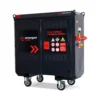
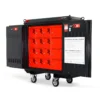
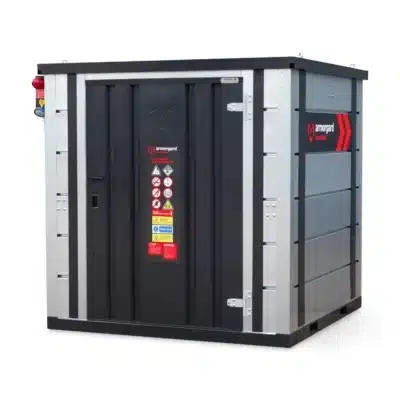
Armorgard PowerStor: The Ultimate for Outside Safety
When it comes to isolating a Class L fire risk, distance is your best friend. The Armorgard PowerStor is the ultimate heavy-duty, walk-in solution designed specifically for outdoor use. By moving your high-volume battery charging completely out of the site office or main facility, you are removing the hazard from your most valuable assets and personnel. It arrives pre-assembled and is the go-to choice for massive construction sites that need a central, isolated charging hub.
Key Features & Benefits:
Patented F.I.R.E.E. Technology: (Fire Integrated Reactive and Enhanced Engineering) This system acts instantly to danger without manual intervention. It combines active ventilation, temperature regulation, and automatic power cut-off if the internal temperature hits 60°C.
Automated Fire Suppression: Features an unpressurised aerosol system that releases certified fire suppressant directly at the source. It remains airborne for over 40 minutes to interrupt the chemical reaction and prevent re-ignition.
High-Capacity Setup: Features 5 heavy-duty locking shelves with up to 32 individually switchable 230V power outlets with RCD protection, all operating from a single, simple 32A/230V supply.
Mobility & Site Security: Built from 1mm and 2mm galvanised steel with twin 5-lever deadlocks to prevent theft. Forklift pockets and crane lifting eyes make it incredibly easy to relocate as the site evolves.
-
Armorgard PowerStor – Secure Li-Ion Battery Charging Store
From £16,782.00 Ex. VAT Select options This product has multiple variants. The options may be chosen on the product page
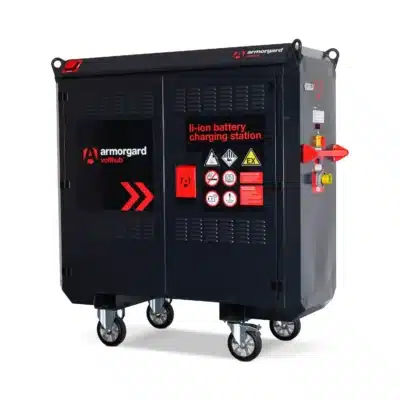
Armorgard VoltHub: The Dedicated Safe Zone
Similar to the PowerStor but highly adaptable for specific workflows, the VoltHub is a dedicated, secure charging station providing a centralized, heavily protected hub for multiple users. Rated IP55 for both indoor and outdoor use, it is perfect for large sites where multiple tradesmen need a safe, compartmentalised place to drop their batteries at the end of a shift.
Key Features & Benefits:
Intelligent Thermostatic Control: Lithium-ion batteries are sensitive to temperature changes. The VoltHub’s internal fan activates at 20°C to proactively cool charging batteries, while an integrated heater warms the unit if temperatures drop below freezing, preventing irreversible sub-zero charging damage.
Critical Safety Cut-Off: If the internal enclosure temperature reaches the danger zone of 60°C, the power supply to the sockets is instantly cut off, but forced ventilation continues to exhaust hazardous off-gases.
GSM Remote Alerts: Should the fire suppression activate or off-gases be detected, the built-in GSM module instantly alerts up to three pre-programmed mobile numbers via text and phone call, ensuring site managers are notified 24/7.
Localised Fire Suppression: If thermal runaway occurs, a localised suppressant deals directly with the fire in that specific compartment, bringing instantaneous cooling and reducing the risk of thermal propagation to adjacent lockers.
-
Armorgard VoltHub – Li-Ion Battery Charging Station
From £12,100.00 Ex. VAT Select options This product has multiple variants. The options may be chosen on the product page
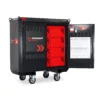
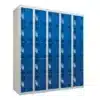
QMP Power Tool Battery Charging Lockers: The Workhorse for 90% of Sites
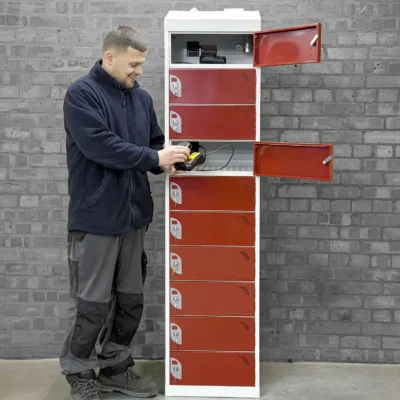
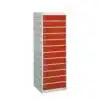
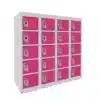
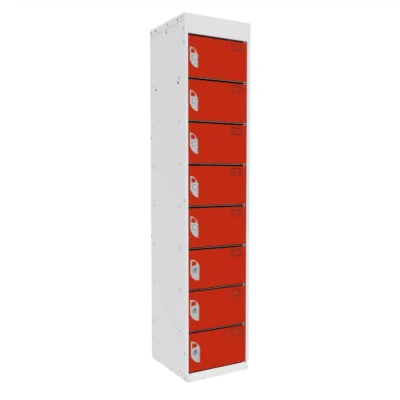
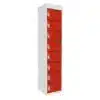
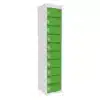
For the vast majority of contractors, workshops, and facilities managers, space is at a premium and charging needs to happen indoors. The QMP Power Tool Charging Lockers are the perfect fit for 90% of indoor applications. They provide strict compartmentalisation so that workers can securely lock away their expensive batteries while they charge safely throughout the day.
Key Features & Benefits:
Individual RCD Protection: Each lockable compartment contains standard 3-pin plug sockets, completely eliminating the dangerous practice of workers daisy-chaining extension leads across the floor.
Strict Compartmentalisation: Robust steel construction ensures that if one battery fails, the fire is physically restricted from jumping to adjacent compartments, starving the fire of collateral fuel.
Active Hygiene & Durability: Manufactured in the UK from robust steel, these lockers are powder-coated with an exclusive Germ Guard Active Technology anti-bacterial compound, drastically reducing cross-contamination on busy sites.
Ventilated Doors: Designed with engineered ventilation slots to allow the natural heat generated during the charging cycle to dissipate safely.
-
QMP Power Tool & Battery Charging Lockers
From £598.00 Ex. VAT Select options This product has multiple variants. The options may be chosen on the product page
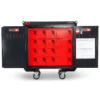
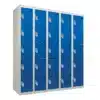
QMP Fire Suppression Charging Lockers: The Ultimate Insurance Policy
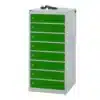
If you are charging batteries inside high-value facilities, heritage buildings, warehouses, or densely populated offices, physical steel is sometimes not enough. These QMP lockers represent the gold standard in indoor protection. They combine the compartmentalised security of a standard locker with automated, built-in fire suppression technology.
Key Features & Benefits:
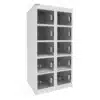
Integrated Fire Suppression: Each tier of the locker is equipped with an automatic fire suppression unit. If a battery enters thermal runaway, the system activates to cool the battery and suffocate the blaze before it breaches the locker.
High-Level Security: Features uncompromising 0.7mm mild steel construction, continuous piano hinges, and heavy-duty 10-disc key-operated mastered cam locks (with 2,000 differs) to secure expensive company hardware.
Certified Safety Standards: Fully CE tested to meet rigorous EU safety requirements and backed by an EN 13501-1 Reaction to Fire Classification.
Space-Saving Modularity: The units arrive fully assembled and pre-drilled for effortless side-by-side nesting, allowing maintenance teams to easily build custom banks of lockers that utilise dead space.
-
QMP Fire Suppression Charging Lockers
From £1,923.00 Ex. VAT Select options This product has multiple variants. The options may be chosen on the product page
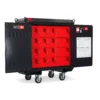
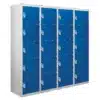
QMP Laptop, Tablet & Mobile Phone Ranges: Protecting the Site Office
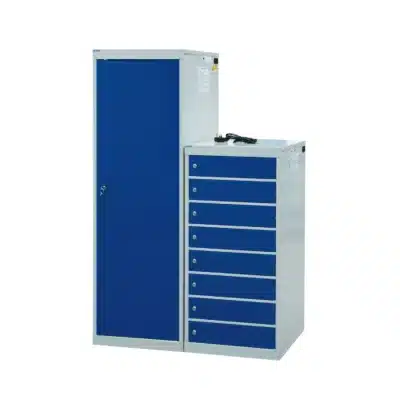
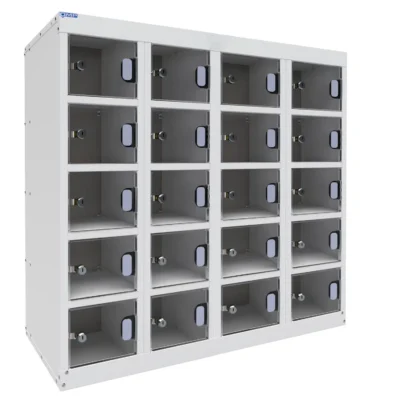
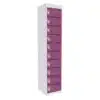
It is a fatal error to focus solely on power tools while ignoring the site office. Administrative devices represent a massive Class L fire risk, especially when left charging overnight in highly combustible, paper-filled cabins. Our ranges of QMP Laptop Trolleys, Tablet USB Lockers, and Mobile Phone Charging Lockers ensure that these devices are managed safely.
Key Features & Benefits:
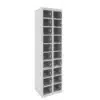
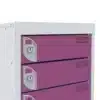
Dual USB & Mains Charging: Compartments feature versatile dual charging facilities, offering a standard 3-pin socket alongside a modern USB-C connectivity port for direct, fast-charging flexibility.
Centralised Power Management: To eliminate cable clutter and overloaded wall sockets, the entire multi-tier locker unit is powered by a single, simple kettle lead that plugs directly into the mains.
Anti-Theft Construction: Built to protect high-value IT equipment, these units can be configured with a variety of access options, from standard cam locks to advanced digital keypads with programmable PIN codes.
Perforated Ventilation: Engineered with extensive ventilation throughout the carcass and doors to stop laptops and tablets from overheating while they charge in confined spaces.
-
QMP Laptop Charging Lockers
From £757.00 Ex. VAT Select options This product has multiple variants. The options may be chosen on the product page -
QMP Mobile Phone Charging Lockers
From £622.00 Ex. VAT Select options This product has multiple variants. The options may be chosen on the product page -
QMP Dual USB Tablet Charging Lockers
From £458.00 Ex. VAT Select options This product has multiple variants. The options may be chosen on the product page
FAQ's
1. Standard extinguishers fail against Class L fires, so what should we use?
If a lithium-ion battery ignites outside of a specialized containment locker, traditional water, foam, or CO2 extinguishers will not stop the chemical reaction. You need a specialized AVD (Aqueous Vermiculite Dispersion) fire extinguisher. AVD extinguishers discharge a fine mist that creates a physical, heat-resistant film over the battery, cooling it rapidly and cutting off the oxygen supply to prevent thermal propagation.
2. Are there warning signs before a battery goes into thermal runaway?
Yes. Workers should be trained to look, listen, and smell for warning signs. If a battery is unusually hot to the touch when not in use, begins to visibly swell or bulge, emits a hissing or popping sound, or releases a sickly, sweet-smelling gas, it is actively failing. It must be unplugged immediately (if safe to do so) and moved to a safe outdoor quarantine zone.
3. Do expensive, branded power tool batteries still pose a risk, or is it just cheap knock-offs?
While cheap, uncertified aftermarket batteries lack essential safety components and are notoriously dangerous, premium branded batteries (DeWalt, Makita, Milwaukee, etc.) still pose a risk on a construction site. Premium batteries have an internal Battery Management System (BMS) to prevent overcharging. However, if a battery is dropped from a scaffold, left in a freezing van, or crushed, the internal cells and the BMS can be physically damaged, completely bypassing those built-in safety features.
4. Can we safely leave batteries charging overnight unattended?
You should never leave batteries charging overnight on open desks or standard workbenches. If your operational workflow requires overnight charging so batteries are ready for the morning shift, it must only be done inside automated, fire-suppressed, or externally isolated equipment like the Armorgard PowerStor or QMP Fire Suppression Lockers.
5. How do we safely dispose of a damaged or swollen lithium-ion battery on site?
Do not throw them in general site skips—this is a leading cause of waste management fires. Damaged batteries must be immediately quarantined in a dedicated, fire-resistant battery disposal bin (ideally filled with fire-retardant granules or sand) situated outdoors and away from buildings. You must then arrange for collection by a certified hazardous waste disposal contractor.
6. Do these heavy-duty charging lockers require specialist electrical installation?
In most cases, no. Products like the QMP Power Tool and Laptop Charging Lockers operate via a standard 230V UK kettle lead or 3-pin plug that connects directly into your existing mains supply. Larger outdoor hubs like the Armorgard PowerStor typically run off a simple 32A/230V supply. However, we always recommend consulting with your site electrician to ensure your circuits are not overloaded.
7. Do our charging lockers need to be PAT tested?
Yes. Because these lockers and hubs contain electrical components, sockets, and sometimes heaters/fans, they fall under the Provision and Use of Work Equipment Regulations (PUWER) and the Electricity at Work Regulations. The lockers, along with the chargers plugged into them, should be subjected to regular Portable Appliance Testing (PAT) and visual inspections to ensure the cables and sockets remain undamaged.
8. Are worker e-bikes and e-scooters covered under these same Class L site risks?
Absolutely. In fact, e-bikes and e-scooters are currently one of the highest causes of Class L fires in the UK due to their massive battery capacities and the prevalence of unregulated aftermarket chargers. Site managers must establish a strict policy regarding micromobility vehicles. They should never be charged inside the site office or main building; they require their own dedicated outdoor, fire-rated charging points.
9. What is the protocol if a locker’s fire suppression system actually goes off?
If a locker successfully suppresses a thermal runaway event, the area must still be treated as a hazardous zone. The room should be heavily ventilated to clear any remaining toxic off-gases (like hydrogen and carbon monoxide). Only trained personnel wearing appropriate PPE should open the locker once it has fully cooled. The locker will then need to be professionally cleaned, and the suppression unit must be replaced and recommissioned.
10. What specific training should I provide to my site workers regarding Li-ion batteries?
Site managers should integrate Li-ion safety into their regular Toolbox Talks. Training must cover:
Visual inspection of batteries before use (checking for cracks or swelling).
The absolute ban on daisy-chaining extension leads.
The mandatory use of designated charging lockers.
Evacuation protocols if a battery starts hissing or smoking.