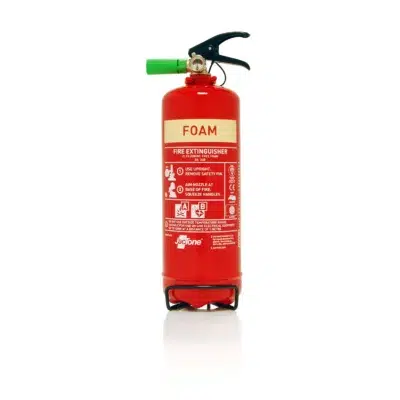
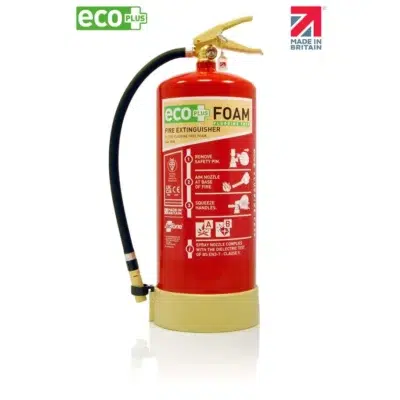
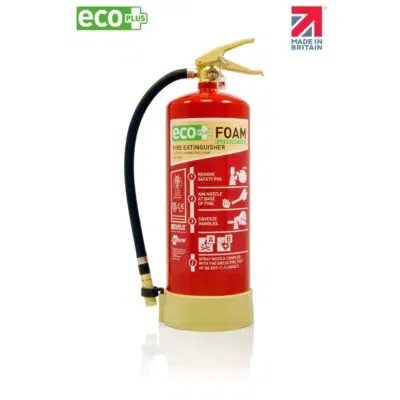
What is a foam fire extinguisher?
A foam extinguisher holds a water-based concentrate and a nitrogen charge. On discharge the mixture expands into a foam that:
- Cools Class A materials
- Floats on and seals Class B liquids, cutting oxygen and vapour
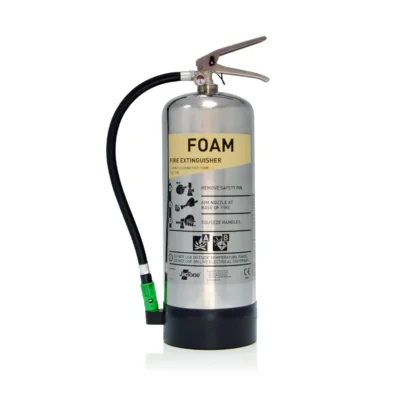
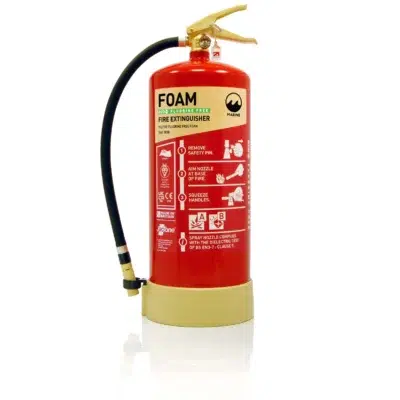
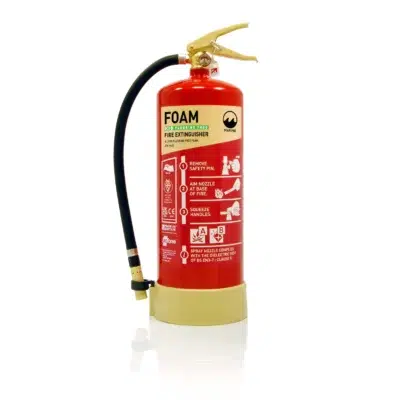
UK identification is a cream handle, header and base on a red body. That is how staff tell foam from water (white), powder (blue), CO2 (black) and wet chemical (yellow) at a fire point.
HSE Store now supplies Eco Plus PFAS-free foam — fluorine-free replacements for older AFFF concentrates that relied on persistent fluorosurfactants. Performance stays in the same A/B class; the chemistry meets current environmental expectations.
What is it used for?
- Mixed-risk workplaces: workshops, warehouses, factories, loading bays
- Garages and plant with fuel, oils and packaging
- Commercial premises where both paper/wood and flammable liquids are present
- Vehicles and compact plant (2 litre)
- Vessels and offshore spaces that need MED-approved A/B protection (Marine 6L and 9L)
Foam is the practical “one cylinder for two common classes” where a water-only unit would fail on a liquid spill and a powder unit would leave a corrosive, hard-to-clean mess.
Who is it for?
Facilities and H&S managers, warehouse and production operators, garage and fleet workshops, contractors, education and logistics sites, and vessel operators specifying MED kit. Provision must still follow the site fire risk assessment — foam covers A and B, not every class on the floor.
What problem does it solve?
Most workplaces do not have a single fuel type. A skip fire and a diesel spill can sit in the same bay. Water will not seal a liquid; CO2 will not wet a stack of cardboard; powder works on both but contaminates stock and plant. Foam knocks the flame down and leaves a blanket that reduces re-ignition, with a residue you can wash off rather than vacuum out of motors.
Sizes, ranges and specification
| Model | Fire rating | Discharge (avg.) | Typical size | Notes |
|---|---|---|---|---|
| 2L Basic Eco Plus | 5A | 34B | ~19 s | 378 × 110 mm, filled ~4.1 kg | Vehicles, small rooms, compact fire points |
| 6L Premium Eco Plus | 21A | 144B | ~53 s | ~537 × 160 mm, filled ~9.8 kg | Standard workplace size |
| 6L Prestige Eco Plus | Class A & B (6L) | — | Prestige finish, stainless handle | Reception, offices, specified interiors |
| 6L Marine Eco Plus | 21A | 144B | ~56 s | 517 × 160 mm, filled ~9.9 kg | MED / SI 2016/1025 |
| 9L Premium Eco Plus | 34A | 183B | up to ~80 s | ~552 × 189 mm, filled ~14 kg | Larger floor areas and higher A rating |
| 9L Marine Eco Plus | Class A & B (9L) | — | MED / SI 2016/1025 | Engine rooms, decks, commercial craft |
Common technical points across the range:
- Operating / storage temperature +5 °C to +60 °C — protect from frost
- Operating pressure 15 bar at 20 °C, nitrogen propellant
- Deep-drawn cylinder, internal lining, heavy-duty brass valve
- Spray nozzle assessed to BS EN3-7, Clause 9 (dielectric test)
- Kitemark to BS EN3, UKCA and CE; Marine models add SI 2016/1025
- 5-year guarantee on Premium and Marine models
2L where weight and cupboard space matter. 6L as the default indoor/outdoor workplace extinguisher. 9L where the risk assessment wants a higher A rating and longer discharge. Marine when the vessel or offshore spec demands MED, not just EN3.
How foam works — and where not to use it
Apply at the base of a solid fire; on a liquid spill, aim to float a continuous blanket rather than plunge the jet into the fuel (that can spread burning liquid). Keep an escape route behind you.
Do not specify foam as the primary agent for:
- Class F cooking oils and fats — use wet chemical
- Lithium-ion thermal runaway — use a dedicated lithium / AVD unit
- Fires that need a clean gaseous agent on energised precision electronics — use CO2, and isolate power
- Unheated external locations that drop below +5 °C unless the unit is in a frost-protected cabinet
Water-based foam conducts. The Clause 9 spray test is not a licence to attack a live high-voltage board. Isolate first if it is safe.
Service under BS 5306-3. After any discharge, replace or refill; a partly used foam unit is not a reliable second shot.
Why buy foam extinguishers from HSE Store
The category is the current Jactone Eco Plus PFAS-free family — 2L, 6L and 9L in Basic, Premium, Prestige and Marine — not leftover AFFF stock described as “eco”. You get published A/B ratings, British manufacture, MED options, and the rest of the fire-point kit (stands, covers, ID signs) from the same place.
Frequently asked questions
What fire classes does foam cover?
Class A solids and Class B flammable liquids. Ratings on this range run from 5A | 34B (2L) to 21A | 144B (6L) and 34A | 183B (9L Eco Plus). Foam is not Class F and is not a lithium-ion extinguisher.
Is Eco Plus the same as old AFFF?
No. Eco Plus is PFAS-free / fluorine-free foam. It still forms a cooling, sealing blanket on A and B fires, without the persistent fluorosurfactants used in traditional AFFF.
2 litre, 6 litre or 9 litre?
2L for vehicles and tight spaces. 6L for most workplaces. 9L where you want the higher A rating and a longer discharge on a larger floor or higher fuel load.
Can I use foam on electrical equipment?
The spray nozzles meet the BS EN3-7 Clause 9 dielectric test, but the agent is still water-based. Isolate the supply if you can. For dedicated electrical protection with no residue, specify CO2.
Why is the operating temperature only +5 °C to +60 °C?
The charge can freeze. Do not site foam extinguishers in unheated vans, yards or plant rooms that drop below +5 °C unless they are in a frost-protected cabinet. Powder or CO2 may be the better external choice in winter.
Do Marine foam extinguishers fight a different fire?
Same A/B foam duty. The difference is approval: Marine 6L and 9L meet the Merchant Shipping (Marine Equipment) Regulations SI 2016/1025 as well as BS EN3 / UKCA / CE.