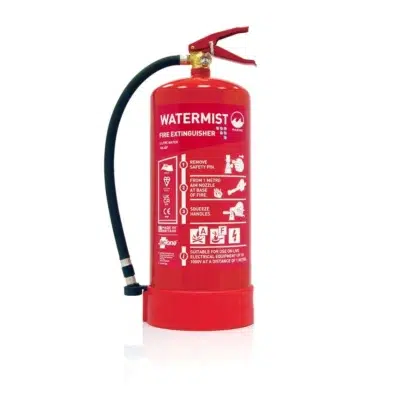
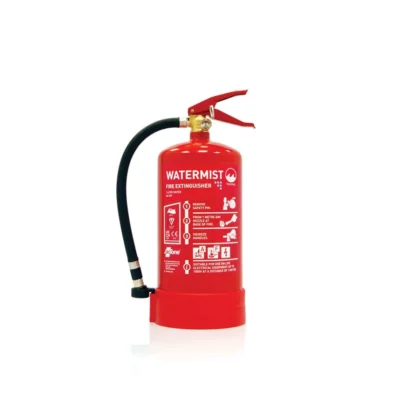
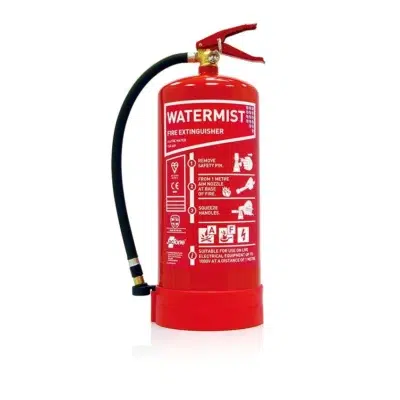
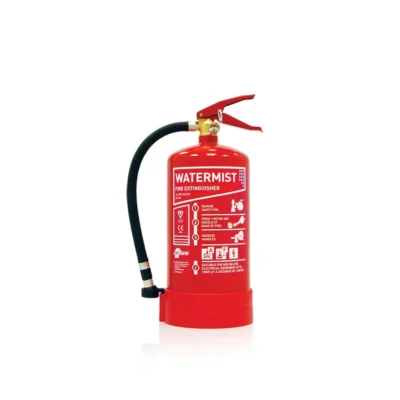
What is a water mist fire extinguisher?
A water mist unit stores water and nitrogen, then breaks the discharge into a fine droplet cloud instead of a solid jet. The mist:
- Cools Class A materials with less run-off than a conventional water extinguisher
- Can knock down cooking-oil fires (Class F) at the published F rating
- Has been fire-tested on Class B liquids (not EN3-certified for B)
- Can be used on live electrical equipment up to 1000 V from 1 metre
It is a different appliance from a standard water extinguisher (Class A jet only) and from wet chemical (saponifying Class F specialist). Do not treat the three as interchangeable.
What is it used for?
- Vessels: accommodation, engine spaces, small galleys
- Hotels, offices and public interiors where powder would contaminate finishes
- Mixed points where solids, a small oil risk and nearby electrics sit together
- Sites that want Class A + F cover without a second cylinder
The practical reason to buy mist is one clean, multi-duty point with less water damage than a 9L jet and no ABC powder cloud.
Who is it for?
Marine operators and yacht owners who need MED kit; facilities managers in hospitality and offices; estates that want a low-residue A/F option next to small cooking and electrical risks. Large commercial kitchens should still put a dedicated 6L wet-chemical extinguisher on the fryer line.
What problem does it solve?
A water jet floods and is wrong on oil and boards. Powder wrecks interiors. CO2 has no A or F rating on the models we sell. Wet chemical is right for a fryer bank but is a specialist kitchen tool. Mist sits in the gap: cooling, a published F rating, 1000 V electrical use, and a mop-up rather than a strip-out.
Sizes, ranges and specification
| Model | EN3 rating | B test* | Discharge (avg.) | Size / filled weight | Notes |
|---|---|---|---|---|---|
| Premium / Marine 3L | 8A | 25F | 21B* | ~15.3 s | 435 × 160 mm / 6.1 kg | Compact cabins, offices, small plant |
| Premium / Marine 6L | 13A | 40F | 34B* | ~26.7 s | 552 × 189 mm / 11 kg | Larger floors, vessels, higher F rating |
*Jactone Class B fire tests. Not certifiable under BS EN3 because the test fires fall outside EN3 size limits.
Common points:
- Agent: water. Propellant: nitrogen. 15 bar at 20 °C
- Operating / storage +5 °C to +60 °C — protect from frost
- Electrical: up to 1000 V at 1 metre
- Kitemark to BS EN3, UKCA, CE
- Marine 3L and 6L: SI 2016/1025 (MED)
- 5-year guarantee on listed models
3L where weight and cupboard space matter. 6L where you want 13A and 40F. Marine when the vessel spec demands MED.
How to use it — and the limits
Aim at the base of a solid fire from about a metre. On a small Class F fire, apply in a gentle sweeping action — do not plunge a jet into hot oil. On electrics, keep the labelled 1 m distance.
Do not rely on water mist as the primary agent for:
- Large fryer banks — check whether 25F / 40F meets the kitchen risk; a 6L wet chemical is usually the fryer-line spec
- Lithium-ion thermal runaway — use a dedicated lithium / AVD unit
- Unheated locations below +5 °C
- A certified Class B workplace risk — use foam or powder with an EN3 B rating
Service under BS 5306-3. Refill or replace after any discharge.
Why buy water mist from HSE Store
HSE Store stocks the Jactone 3L and 6L water mist family in Premium and Marine, with published A and F ratings, the 1000 V / 1 m electrical note, and MED on the marine pair. Pair them with wet chemical on a serious galley, CO2 on a large electrical room, and PVSTOP if the site has solar.
Frequently asked questions
Is water mist the same as a water extinguisher?
No. A standard water unit is a Class A jet (13A or 21A). Water mist is a fine spray with Class A and F EN3 ratings, 1000 V electrical use at 1 m, and manufacturer Class B tests that are not EN3-certified.
What are the certified ratings?
3L: 8A | 25F. 6L: 13A | 40F. Class B (21B / 34B) is tested only.
Can I use it on live electrical equipment?
Yes, within the label: up to 1000 V, stand 1 metre off. Isolate if you can. It is still water — not a CO2 substitute for a large comms room.
3 litre or 6 litre?
3L for cabins, small offices and tight fire points. 6L for more floor area and the higher 13A | 40F rating.
Does Marine mist fight a different fire?
Same water-mist duty. Marine 3L and 6L add MED approval under SI 2016/1025.
Will it replace a wet-chemical extinguisher in a commercial kitchen?
Not on a large fryer line. 25F and 40F are modest. Keep a 6L wet chemical on the cook line and use mist for mixed accommodation or small galley risks.