Introduction: The Procurement Dilemma
If you work in factory management, manufacturing, or logistics, you are likely all too familiar with the relentless pressure to optimise budgets. Every quarter, purchasing managers and company directors are tasked with reducing capital expenditure while maintaining operational efficiency. In a world driven by spreadsheets and bottom lines, the initial purchase price often becomes the sole deciding factor in procurement.
Drawing upon over 15 years of hands-on experience in manufacturing, factory management, and logistics environments, I have witnessed this exact scenario play out thousands of times. A site needs new equipment—perhaps a fleet of platform trolleys, new racking, or heavy-duty warehouse steps. The purchasing manager sources two options. Option A is imported, likely from Asia, and comes with an attractive price tag of £500. Option B is a British-made equivalent, priced at £750.
To the untrained eye, or to a director simply looking at a budget line, the decision seems obvious. Why on earth should the business pay a 50% premium for what appears to be the exact same product? They correctly wonder what justifies the extra £250.
This is the exact moment where the philosophy of “Ask Not Act” must be applied.
Before clicking “buy,” before signing off on the purchase order, buyers must pause and ask why the product is so much cheaper, rather than acting blindly on the impulse of a lower face value. In heavy industry and logistics, what you don’t know about your equipment can—and eventually will—cost you dearly. This article will dissect the true cost of cheap imports, the catastrophic safety risks they pose, and why the motto “Buy once, not twice” is the only sustainable strategy for a modern, safe, and efficient facility.
The Disconnect: Spreadsheets vs. The Factory Floor
One of the most dangerous traps a business can fall into is the disconnect between the people buying the equipment and the people actually using it. From personal experience managing bustling factory floors, I can tell you that understanding what your staff actually need is the cornerstone of both safety and productivity.
Too often, workplaces operate on a “keyword” basis. A warehouse operative tells their manager, “We need new mobile steps for the picking aisle.” The manager passes this to procurement. Procurement types “mobile warehouse steps” into a search engine, sorts by ‘Price: Low to High,’ and buys the cheapest import that matches the keyword.
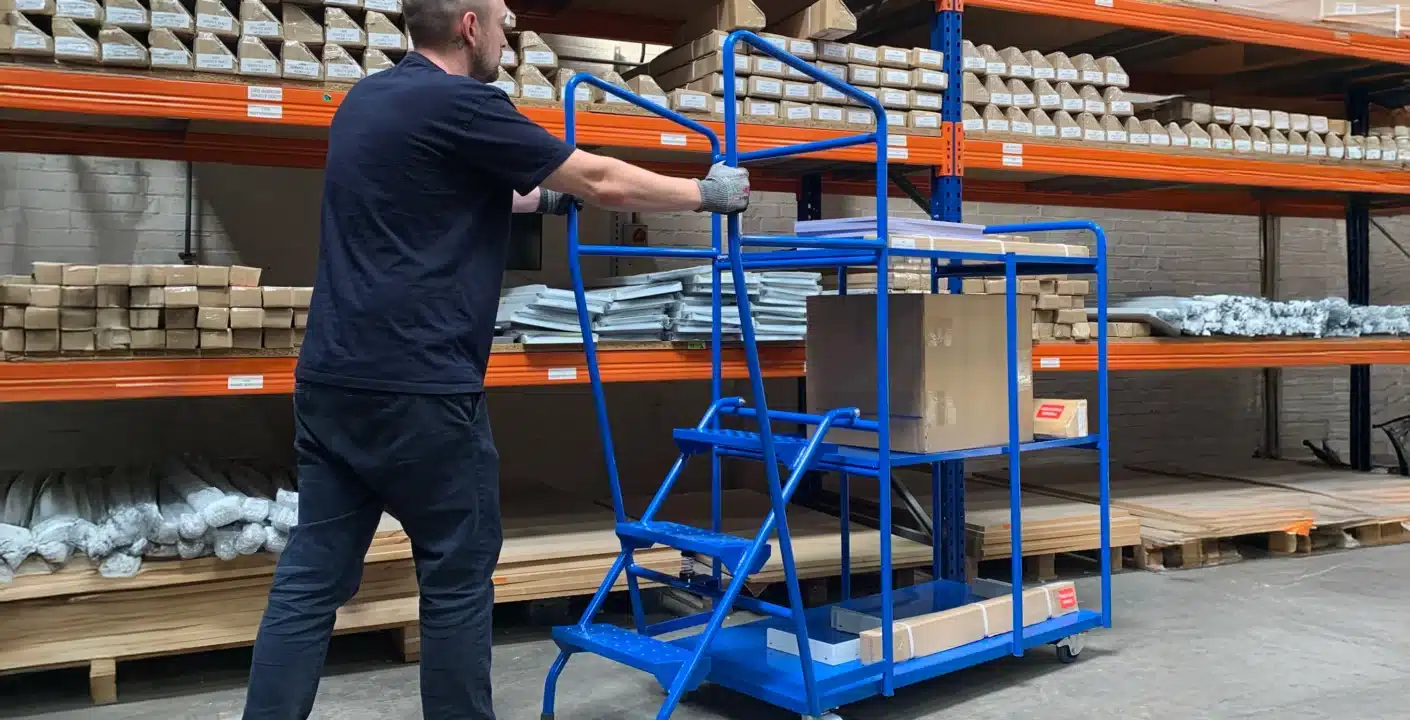
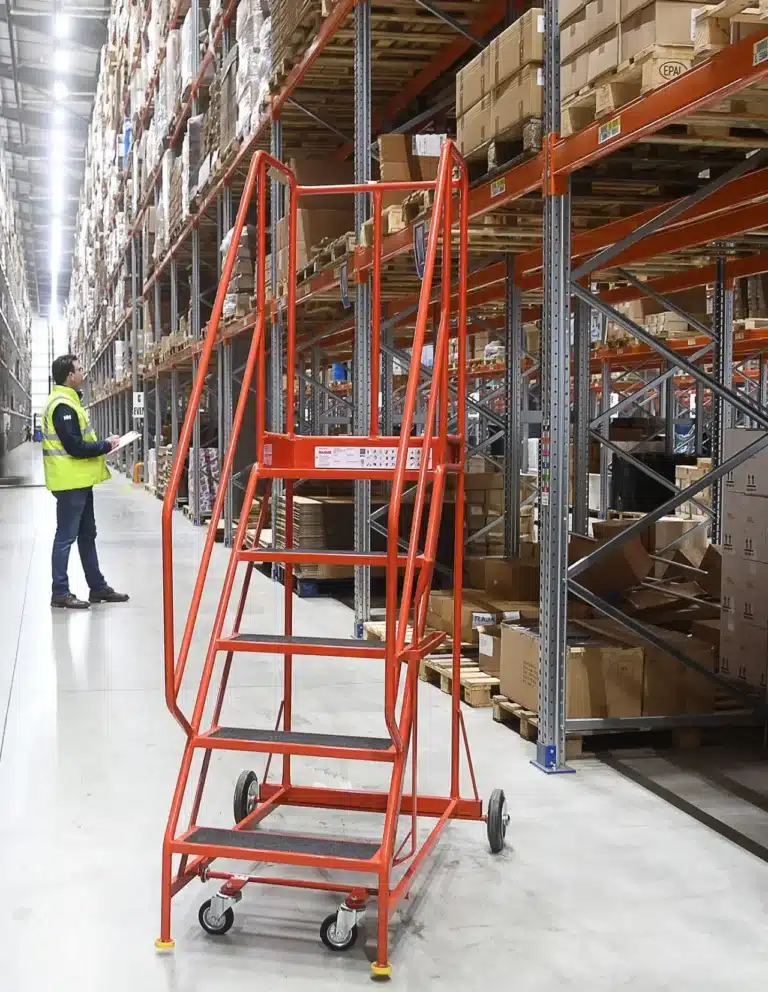
This is a critical failure in management. The buyers are not the ones scaling those steps 40 times a shift with 15kg boxes in their hands. The people using the equipment are the true experts. When that operative asked for “mobile steps,” what they actually needed was equipment with anti-slip treads, a reinforced top platform, a secure braking mechanism, and ergonomic handles.
When buyers ignore the granular needs of their staff to save a few pounds, they aren’t just buying substandard equipment; they are sending a clear message to their workforce: Your safety and daily comfort are worth less than the £250 we saved. Reputable British manufacturers completely understand this dynamic. They don’t just build to a keyword; they build to the reality of the UK warehouse floor. They respond to operator feedback, designing equipment that genuinely benefits the user, reduces fatigue, and actively prevents accidents.
Decoding the "Ask Not Act" Philosophy
The “Ask Not Act” philosophy is a fundamental shift in procurement psychology. It moves the conversation away from initial Capital Expenditure (CapEx) and focuses entirely on Total Cost of Ownership (TCO) and risk mitigation.
When you see a £500 piece of equipment competing against a £750 equivalent, the £250 discrepancy is not simply a matter of profit margins. In the world of steel fabrication and heavy-duty manufacturing, there is no magic trick to drastically reducing costs without drastically reducing quality.
If a product is significantly cheaper, the manufacturer has cut corners to get it to that price point. The “Ask” in “Ask Not Act” requires you to interrogate where those corners were cut.
Was it in the quality of the raw materials?
Was it in the speed and quality of the welding?
Was it in the exclusion of rigorous load-testing?
Was it in the lack of compliance with British and European safety standards?
By asking these questions, you transition from a reactive buyer to an informed investor in your company’s operational infrastructure and your staff’s wellbeing.
Beneath the Paint: The Anatomy of a Cheap Import
To truly understand why imported equipment is cheaper, we have to look beneath the powder coating. On a computer screen, a £500 imported platform trolley looks identical to a £750 British-made one. Both are blue, both have four wheels, and both claim to carry 500kg. However, the physical reality is vastly different.
Inferior Grade Steel: Cheap imported products often utilise lower-grade, thinner-gauge steel to save on material costs and shipping weight. Thinner steel suffers from rapid metal fatigue. British manufacturers typically use high-grade, thick-gauge tubular or box-section steel designed to withstand decades of abuse.
Sub-Par Welding Practices: In mass-production facilities focused purely on volume, welding is often rushed. You will frequently find “tack welds” disguised as full seam welds, excessive weld spatter, and poor penetration. A weak weld is the exact point where the equipment will fail when put under maximum strain.
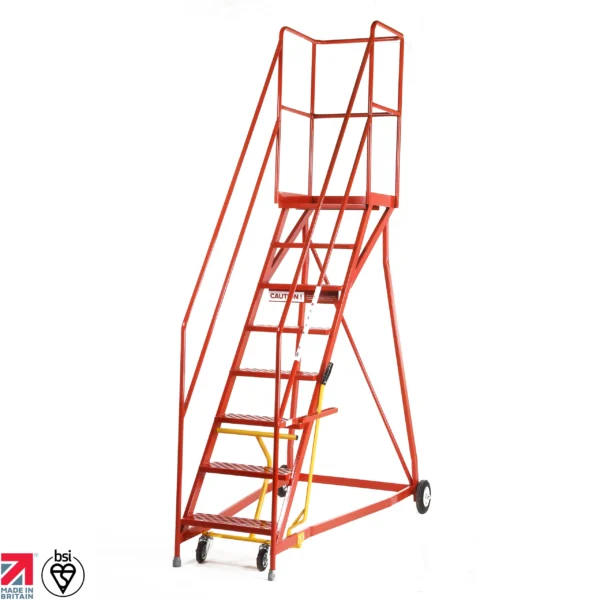
Low-Quality Components: Cheap imports save money on the moving parts—castors, bearings, hinges, and braking mechanisms. A heavy-duty step is completely unsafe if the imported braking castors shatter or fail to lock properly.
-
Steptek Classic Mobile Steps Range (2 – 5 Treads)
From £265.23 Ex. VAT Select options This product has multiple variants. The options may be chosen on the product page -
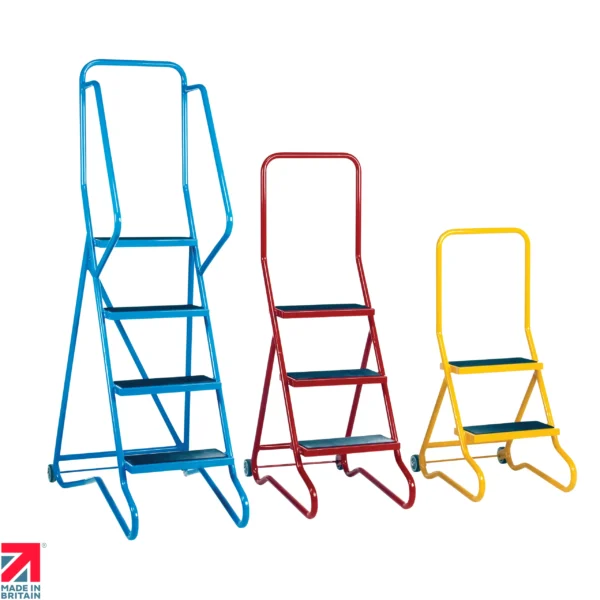
Steptek Narrow Aisle Mobile Steps (2 – 5 Treads) – BS Certified
From £469.18 Ex. VAT Select options This product has multiple variants. The options may be chosen on the product page -
Steptek Heavy Duty Warehouse Steps – BS Certified (3 – 15 Treads)
From £827.53 Ex. VAT Select options This product has multiple variants. The options may be chosen on the product page -
Steptek Wheel Along Portable Steps (2 – 4 Treads)
From £178.25 Ex. VAT Select options This product has multiple variants. The options may be chosen on the product page -
Steptek Single Sided 2-Step Portable Steps
From £201.14 Ex. VAT Select options This product has multiple variants. The options may be chosen on the product page -
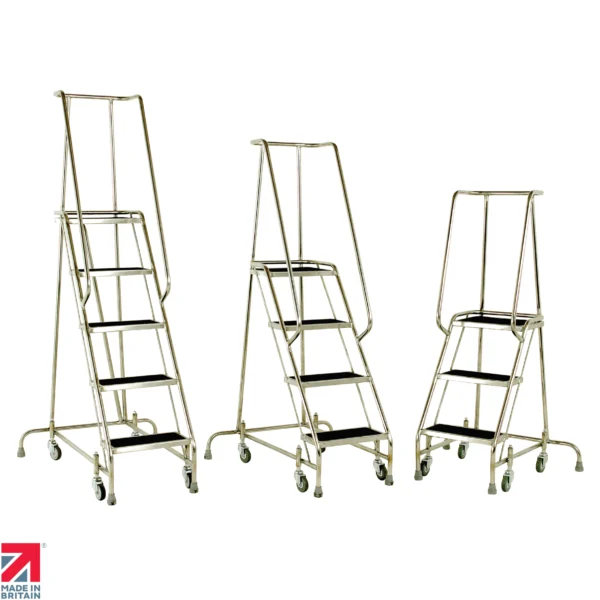
Steptek Stainless Steel Mobile Steps (3 – 5 Treads)
From £906.98 Ex. VAT Select options This product has multiple variants. The options may be chosen on the product page
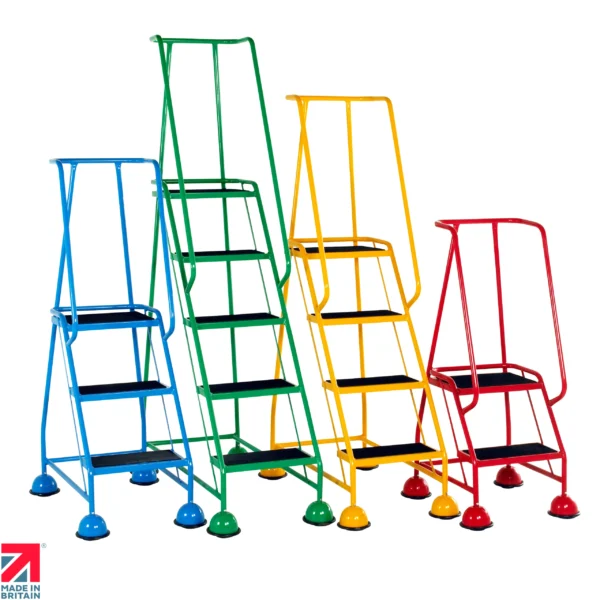
The True Focus: Health, Wellbeing, and Everyday Ergonomics
Health and safety isn’t just about preventing spectacular accidents; it is about protecting the daily physical wellbeing of your staff.
Cheap, poorly designed equipment takes a physical toll on workers. If a trolley has cheap castors, it requires twice as much physical force to push. Over an eight-hour shift, this leads to severe musculoskeletal fatigue, back pain, and joint strain. If warehouse steps wobble slightly because they aren’t perfectly aligned, the user’s body is constantly tensing to maintain balance, leading to chronic fatigue.
When you invest in high-quality, British-made equipment, you are investing in ergonomics. Smooth-rolling bearings, perfectly balanced frames, and considered handle heights mean your staff expend less energy fighting their equipment and more energy doing their jobs safely. A workforce that feels physically supported and listened to is happier, more productive, and significantly less likely to require time off for repetitive strain injuries.
-
Loadtek Beam Trolley
From £296.56 Ex. VAT Select options This product has multiple variants. The options may be chosen on the product page -
EcoWarrior 500kg HD Mesh 4 Sided Platform Truck
From £360.01 Ex. VAT Select options This product has multiple variants. The options may be chosen on the product page -
Loadtek Mesh Sided Shelf Truck
From £1,012.73 Ex. VAT Select options This product has multiple variants. The options may be chosen on the product page -
Loadtek Industrial Tray Trolleys
From £375.36 Ex. VAT Select options This product has multiple variants. The options may be chosen on the product page -
EcoWarrior 500Kg Heavy Duty Mesh Sided Platform Truck
From £212.91 Ex. VAT Select options This product has multiple variants. The options may be chosen on the product page -

Loadtek Drum Trolley Pouring Stand
From £448.06 Ex. VAT Select options This product has multiple variants. The options may be chosen on the product page
The Safety Imperative: When "Cheap" Fails
While ergonomic strain is a slow burn, the consequences of cheap equipment reach a terrifying and instantaneous climax when we discuss products designed to bear human weight.
A buyer, pressured by budget constraints, opts for a cheap, imported set of warehouse steps. The steps arrive, they look sturdy enough, and they are put into circulation. However, because these steps were manufactured to a price point rather than a safety standard, the steel is thin, the welds are rushed, and crucially, they have not undergone strict, independent load-bearing certification.
Six months later, an employee carrying stock steps onto the top platform. The weak weld on the primary support strut gives way. The steps collapse.
-
Loadtek Loop Handle Stairclimber Sack Trucks
From £328.06 Ex. VAT Select options This product has multiple variants. The options may be chosen on the product page -
Loadtek Sack Trucks With Plate Toe
From £148.01 Ex. VAT Select options This product has multiple variants. The options may be chosen on the product page -
Loadtek Traditional Splay Back Sack Trucks
From £233.35 Ex. VAT Select options This product has multiple variants. The options may be chosen on the product page -
Loadtek Rough Terrain Sack Trucks
From £270.51 Ex. VAT Select options This product has multiple variants. The options may be chosen on the product page
The Financial Avalanche: A Real-World Cost Comparison
To truly understand why “buying cheap” is a myth, we must compare the actual cost of a health and safety incident against the cost of buying the correct equipment the first time. Let us look at a stark, realistic scenario.
The “Bargain” Route (The Import)
You purchase the imported warehouse steps for £500. You saved £250 on the CapEx budget. Six months later, the steps suffer a structural failure, and an operative falls.
Here is the financial avalanche that immediately follows:
Operational Downtime: The immediate area is cordoned off. The HSE (Health and Safety Executive) requires the scene to remain untouched for internal and external investigation. For a week, that section of your warehouse is dead. Logistics are rerouted, deliveries are delayed. Estimated cost of a week’s lost productivity: £5,000+.
Staff Absence and Sick Pay: The operative suffers a fractured arm and a concussion. They require three months off work. You must pay their statutory or company sick pay, plus you must hire and train an agency temp to cover their role. Estimated cost of absence and cover: £12,000+.
The Liability Claim: Because the company provided substandard, uncertified equipment—and specifically because the procurement team ignored the floor workers’ needs in favour of a cheaper keyword search—the company is found negligent. The staff member rightfully pursues a personal injury claim against the business. Your employer’s liability insurance pays out, but your premiums skyrocket for the next five years, or worse, you face direct legal fines for breaching the Health and Safety at Work Act. Estimated cost of claim, legal fees, and premium hikes: £30,000+.
The True Cost of the £500 Steps: £47,500. Plus, immeasurable damage to company morale, a destroyed safety record, and a severely distressed employee who was let down by the very people meant to protect them.
The “Ask Not Act” Route (The British Standard)
You listen to your staff. You ask the right questions. You purchase the heavy-duty, certified, British-made warehouse steps for £750.
Operational Downtime: £0.
Staff Absence: £0.
Liability Claims: £0.
Employee Trust & Morale: High. They know management values their safety.
The True Cost of the £750 Steps: £750.
When you look at the stark reality of these two scenarios, the £250 “saving” is exposed for what it truly is: an unacceptable, reckless gamble with human lives and company finances.
-
Redditek 304 Grade Stainless Steel Cabinets
From £903.90 Ex. VAT Select options This product has multiple variants. The options may be chosen on the product page -
QMP Vision Door Cupboards
From £343.04 Ex. VAT Select options This product has multiple variants. The options may be chosen on the product page -
Armorgard TuffBank
From £357.68 Ex. VAT Select options This product has multiple variants. The options may be chosen on the product page -
QMP PPE Storage Cupboards
From £279.67 Ex. VAT Select options This product has multiple variants. The options may be chosen on the product page -

QMP Perforated Door Steel Cupboards – Ventilated & Secure
From £389.88 Ex. VAT Select options This product has multiple variants. The options may be chosen on the product page -
Redditek Clear Door Polycarbonate Cabinets –
From £394.53 Ex. VAT Select options This product has multiple variants. The options may be chosen on the product page

The British-Made Advantage: Traceability and Support
When you apply “Ask Not Act” and choose the British-made product, you are unlocking a comprehensive support system that simply does not exist with cheap imports.
1. Unmatched Traceability and Certification
British manufacturers provide comprehensive data sheets, Safe Working Load (SWL) certificates, and technical manuals. If you are audited by a safety inspector, you can instantly produce the paperwork proving your equipment is rated for the job. You have absolute, legally sound proof that you have fulfilled your duty of care.
2. Easy Access to Spare Parts
Equipment takes knocks; it is a fact of industrial life. If a forklift clips a British-made safety step and damages a castor, you can simply call the manufacturer. Because the product is made in the UK, you can have a high-quality replacement part delivered to your site by 9:00 AM the next day. If you break a part on an imported product, you face non-standard threads and a manufacturer 5,000 miles away. The entire unit usually has to go in the metal skip.
3. Direct Accountability
If the worst happens and there is a genuine manufacturing defect, you have a local, legally accountable entity to deal with. A UK manufacturer will swiftly address the issue to maintain their reputation and comply with strict UK consumer and commercial laws. Try seeking accountability from an anonymous seller on an overseas wholesale portal.
-
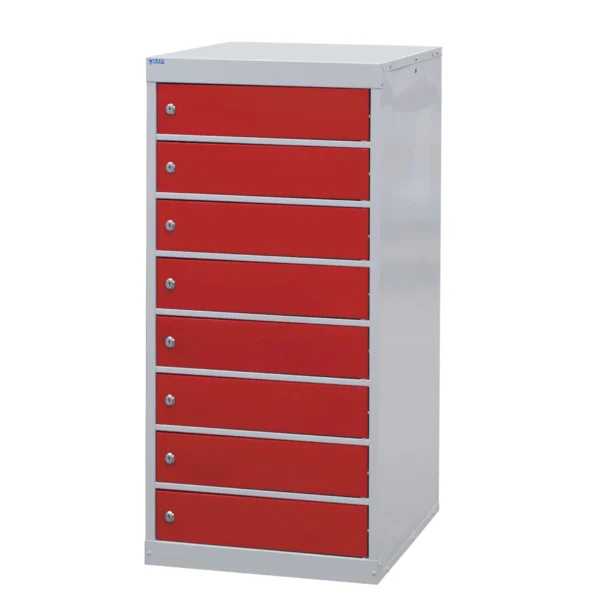
QMP Laptop Storage Lockers – 8 Door – 8 Compartment
£478.54 Ex. VAT Select options This product has multiple variants. The options may be chosen on the product page -
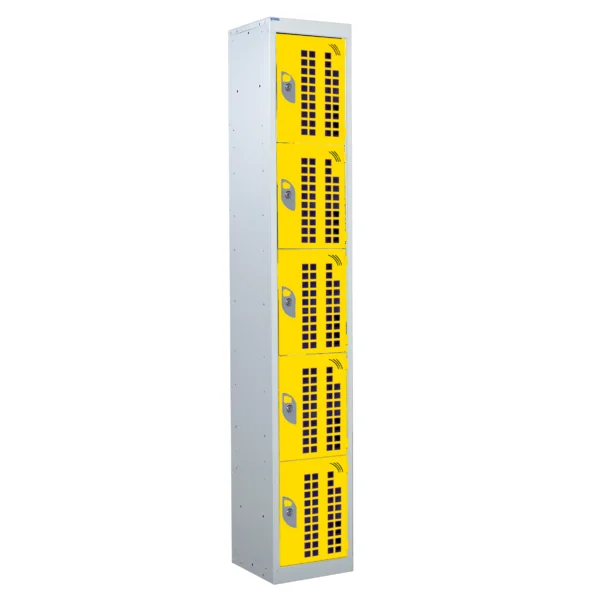
QMP Perforated Lockers – 5 Door
From £230.20 Ex. VAT Select options This product has multiple variants. The options may be chosen on the product page -
QMP Solid Laminate Door Lockers – 3 Door
From £360.71 Ex. VAT Select options This product has multiple variants. The options may be chosen on the product page -

QMP Laptop Storage Lockers – 1 Door – 12 Compartment
£436.87 Ex. VAT Select options This product has multiple variants. The options may be chosen on the product page -
QMP Padlock Lockers – 2 Door
From £179.68 Ex. VAT Select options This product has multiple variants. The options may be chosen on the product page -
QMP Laptop Charging Lockers – 1 Door – 8 Compartment
£750.17 Ex. VAT Select options This product has multiple variants. The options may be chosen on the product page
Total Cost of Ownership: The Long-Term Economics
Even setting catastrophic accidents aside, let us break down the true economics of the “Buy once, not twice” motto over a standard five-year operational period for non-weight-bearing equipment like a platform trolley.
Scenario A: The Cheap Import (Face Value: £500)
Year 1: Purchased for £500.
Year 2: Flimsy castors fail. Cannot source spares. Trolley is scrapped. A new one is purchased for £550 (accounting for inflation).
Year 3: Trolley suffers structural bending due to thin steel. Slows down operations.
Year 4: Welds shear on the handle. Trolley is scrapped. A third unit is purchased for £600.
Year 5: Total expenditure: £1,650. (Plus the hidden costs of operational downtime, disposal fees, and procurement administrative time).
Scenario B: The British-Made Equivalent (Face Value: £750)
Year 1: Purchased for £750.
Year 2: Operating perfectly.
Year 3: Accidental damage to one wheel. Spare part ordered from UK supplier for £30.
Year 4: Operating perfectly.
Year 5: Total expenditure: £780.
Over five years, the “expensive” £750 British-made trolley is actually less than half the price of the “cheap” import. This simple mathematical reality is what purchasing managers must present to directors when fighting for budget approvals.
-
QMP Premium Electric Height Adjustable Workbench – Kit A
From £2,002.08 Ex. VAT Select options This product has multiple variants. The options may be chosen on the product page -
QMP Express Square Tube ESD Workbench – Kit D
From £1,809.14 Ex. VAT Select options This product has multiple variants. The options may be chosen on the product page -
QMP Pack Tek Dual Workbench – Packing Station Kit 1
From £3,541.87 Ex. VAT Select options This product has multiple variants. The options may be chosen on the product page -
QMP Express Cantilever ESD Workbench – Kit F
From £2,220.54 Ex. VAT Select options This product has multiple variants. The options may be chosen on the product page -
QMP Premium Electric Height Adjustable Workbench – Kit F
From £3,075.27 Ex. VAT Select options This product has multiple variants. The options may be chosen on the product page -
QMP Express Square Tube Workbench – Kit D
From £1,530.39 Ex. VAT Select options This product has multiple variants. The options may be chosen on the product page
Implementing "Ask Not Act" in Your Business
Changing a deeply ingrained procurement culture takes time, but it starts with a few practical steps that every warehouse manager, health and safety officer, and purchasing director can implement immediately.
Bridge the Gap: Mandate that procurement teams must consult with the actual end-users before purchasing any equipment. Stop buying based on keyword searches and start buying based on operational reality.
Establish a TCO Requirement: Require that all equipment procurement requests include a basic Total Cost of Ownership projection, not just the initial price.
Demand Certification: Refuse to purchase any weight-bearing equipment that does not come with verifiable UK or European safety standard certifications (such as BS EN 131 for ladders).
Assess the “Spares” Availability: Before buying, ask the supplier: “If I break a specific component in two years, how quickly can you get me the exact replacement part?” If they cannot guarantee rapid spare parts, walk away.
-
Loadtek Heavy Duty Cylinder Wall Racks
From £77.64 Ex. VAT Select options This product has multiple variants. The options may be chosen on the product page -
Loadtek Oxygen Cylinder Trolleys
From £341.08 Ex. VAT Select options This product has multiple variants. The options may be chosen on the product page -
Loadtek Cylinder Lifting Trolleys
From £468.37 Ex. VAT Select options This product has multiple variants. The options may be chosen on the product page -
Loadtek Cylinder Storage Racks
From £140.25 Ex. VAT Select options This product has multiple variants. The options may be chosen on the product page -
Loadtek Propane & Calor Cylinder Trucks
From £264.16 Ex. VAT Select options This product has multiple variants. The options may be chosen on the product page -
Loadtek Economy Cylinder Wall Racks
From £44.59 Ex. VAT Select options This product has multiple variants. The options may be chosen on the product page
Conclusion: Buy Once, Not Twice
At HSE Store, we completely understand the pressure businesses are under to remain lean and profitable. However, true profitability does not come from saving pennies on the tools that keep your business moving; it comes from maximising uptime, ensuring absolute workforce safety, and investing in assets that endure.
The initial face value of a product tells you nothing about its true cost. By embracing the “Ask Not Act” philosophy, you empower yourself to look past the illusion of a bargain. When you choose high-quality, British-made equipment, you are choosing superior metallurgy, guaranteed safety compliance, and unparalleled after-sales support.
More importantly, you are choosing to listen to your staff and protect their wellbeing. Do not wait for a catastrophic equipment failure, weeks of downtime, and a lengthy liability claim to realise the true value of quality. Protect your budget, protect your operations, and most importantly, protect your people. Buy once, not twice.