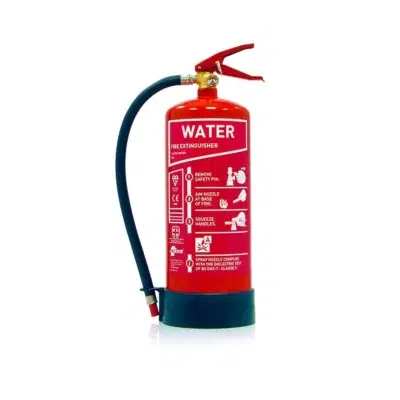
What is a water fire extinguisher?
A water extinguisher holds potable-quality water and a nitrogen charge. On discharge the jet soaks and cools Class A fuel so pyrolysis stops. There is no film-forming foam and no dry chemical. Clean-up is mopping, not vacuuming powder out of plant.
In UK colour-coding the body is red; water points are marked for Class A only. Do not confuse them with water mist (a different nozzle and a wider class list) or with foam (cream coding, A and B).
What is it used for?
- Offices, schools, hotels, retail and public buildings
- Warehouses and stockrooms of paper, packaging and textiles
- Any workplace where the assessed risk is solid combustibles and a clean agent is preferred
Water is still the cheapest compliant way to put a rated Class A extinguisher on a fire point.
Who is it for?
Facilities and H&S managers, education and healthcare estates, retail and hospitality operators, and vessel owners who need a MED Class A unit on accommodation or store spaces. It is the wrong default for garages, spray shops and kitchens — those need foam, powder or wet chemical as the risk dictates.
What problem does it solve?
Most buildings still burn paper, wood and fabric first. Powder works on those fires but leaves a corrosive cloud. Foam works on A and B but costs more and is the wrong label if there is no liquid risk. Water gives a high A rating, a long discharge and almost no contamination of stock. That is why it remains the standard office and school extinguisher.
Sizes, ranges and specification
| Model | Fire rating | Discharge (avg.) | Typical size / filled weight | Notes |
|---|---|---|---|---|
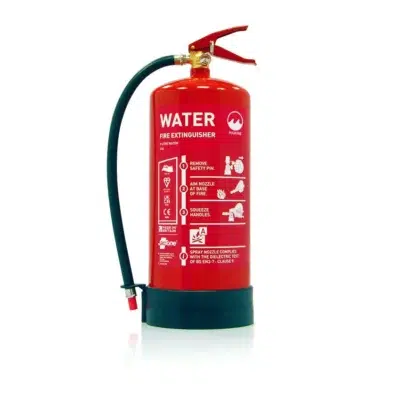
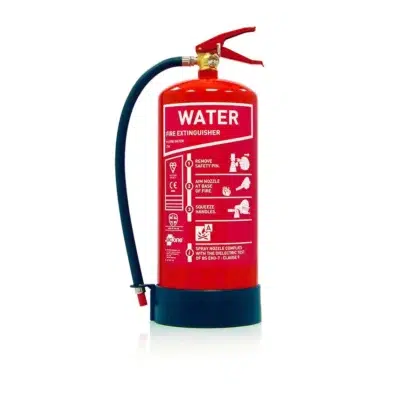
| Premium 6L (EWS6) | 13A | ~45.3 s | 517 × 160 mm / ~9.75 kg | Default indoor size |
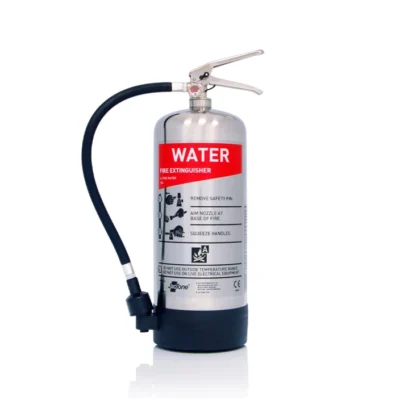
| Prestige 6L | Class A (6L) | — | Prestige polished finish, stainless handle | Reception and specified interiors |
| Premium 9L (EWS9) | 21A | ~52.6 s | 552 × 189 mm / ~14 kg | Higher A rating, longer discharge |
| Marine 9L | Class A (9L) | — | MED / SI 2016/1025 | Vessels and offshore |
Common points:
- Operating / storage +5 °C to +60 °C — do not freeze
- 15 bar at 20 °C, nitrogen propellant
- Deep-drawn cylinder, internal lining, heavy-duty brass valve, pressure indicator
- Spray nozzle tested to BS EN3-7, Clause 9
- Kitemark to BS EN3, UKCA, CE; Marine 9L adds SI 2016/1025
6L / 13A for typical offices and classrooms. 9L / 21A where the assessment wants a higher A rating or a longer jet on a larger floor. Prestige when appearance is part of the spec. Marine 9L when the vessel certificate requires MED, not only EN3.
How to use it — and where not to
Aim at the base of the burning material and soak it. Work from the near edge outward. Keep an escape route behind you.
Do not use a standard water extinguisher on:
- Class B flammable liquids — the jet will spread burning fuel
- Class F cooking oils — use wet chemical
- Class C gases
- Lithium-ion batteries — use a dedicated lithium / AVD unit
- Live electrical equipment — water conducts. Isolate first. Clause 9 is a spray test, not permission to attack a live board
Service under BS 5306-3. After any use, refill or replace.
Why buy water extinguishers from HSE Store
HSE Store stocks the current Jactone 6L and 9L water family in Premium, Prestige and Marine — published 13A and 21A ratings, British manufacture, MED on the 9L marine unit, and the stands and Class A signs to finish the fire point. For mixed A+B risk see foam; for electrics see CO2; for fryers see wet chemical.
Frequently asked questions
What fires can a water extinguisher put out?
Class A solids only — wood, paper, textiles and similar. The 6 litre Premium is rated 13A; the 9 litre Premium is rated 21A. It is not for liquids, gases, cooking oil or lithium-ion batteries.
6 litre or 9 litre?
6L (13A) for most offices, classrooms and small floors. 9L (21A) where you want the higher A rating and a longer discharge.
Can I use water on electrical equipment?
No as a first rule. Isolate the supply if it is safe. The nozzle meets BS EN3-7 Clause 9, but the agent is still water. For residue-free electrical protection specify CO2.
Will it freeze?
Yes if stored below +5 °C. Do not hang water extinguishers in unheated yards, vans or plant rooms without frost protection. Powder or CO2 is the better cold-weather choice.
Water or foam for a warehouse?
Water if the risk is packaging and combustibles only. Foam if there are also fuels, oils or solvents on the same floor. Match the cylinder to the fire risk assessment, not to habit.
What does the Marine 9L add?
Same Class A water duty as Premium 9L, plus MED approval under the Merchant Shipping (Marine Equipment) Regulations SI 2016/1025 for vessels and offshore use.