
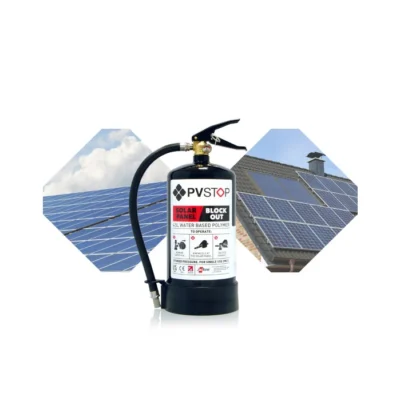
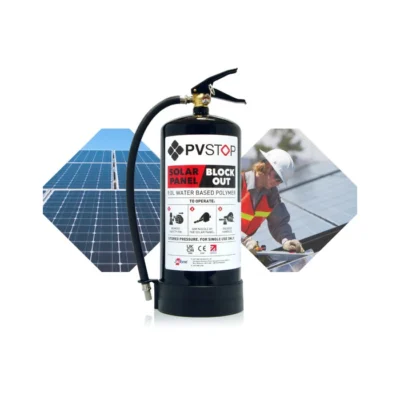
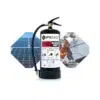
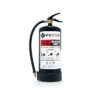
What is PVSTOP Solar Panel Block Out?
PVSTOP is a water-based polymer delivered from a stored-pressure cylinder that looks similar to an extinguisher but is not one. Sprayed onto the face of a solar module, it forms an opaque film that stops photons reaching the cells. Because photovoltaic generation depends on light, blocking that light isolates the DC output at the panel — the “DC Danger Zone” that remains live whenever the array is illuminated.
A domestic system can still deliver 6–8 amps at up to 600 V after the AC isolator is opened. Commercial and industrial strings can sit at up to 1,500 V. DC has no frequency, so a conventional AC “hot stick” cannot confirm it is dead. First responders and electricians must treat every illuminated array as live unless the light path is blocked.
The polymer is black, non-toxic and non-conductive. In the wet state it is fire-retardant; once dry it is non-flammable, waterproof and insulating. It does not damage module glass and peels off by hand or with a pressure washer when the system is ready to return to service. Dry film can remain exposed for up to 12 months. Do not apply it to acrylic surfaces.
What is it used for?
- Emergency isolation during fire, flood or storm when panels cannot be approached safely with water alone
- Stopping re-ignition on PV-fed electrical fires (water can knock flames down; generation often restarts the fire)
- Making an array electrically safe after a short circuit or burning smell, before an electrician attends
- Planned isolation for roof work, inverter replacement, or maintenance where DC isolation at source is required
Case deployments include London Fire Brigade school and terrace-house incidents, a US solar EV charging canopy where water failed and the fire re-ignited, and a Netherlands domestic fault where thermal imaging still showed heat after AC isolation.
Who is it for?
Trained users only: fire and rescue and first responders; electrical technicians and maintenance contractors; PV system operators; and site owners who have been briefed on risk assessment. Untrained personnel must not apply it. A 360° dynamic risk assessment is required before use (access, roof integrity, falling debris, overspray, bystanders, weather).
How PVSTOP works on an array
Cells in a module are wired in series; modules are then strung in series. Coating a continuous strip across the centre ~40% of the array breaks the series path. Voltage may still be present on uncoated cells, but current falls to zero, so power (watts) is zero. Best practice is then to continue until the array is fully coated or the cylinder is empty. Full coverage also makes later peel-off easier and protects the glass.
Apply furthest panels first: throw drops as cylinder pressure falls. Hold the unit vertical. Pull pin, aim at the modules, squeeze. Wear eye, hand and respiratory PPE. Do not spray people or animals.
Theoretical coverage is about 4 m² per litre at 250 micron wet film thickness (100 micron dry). Thicker films reduce area and increase drying time. Wind, rain and operator distance change real-world coverage. Delivery range is up to 10 m in still conditions.
At 25°C and 250 µm WFT the film is tack-dry in roughly 4–5 minutes and tack-free in about 120 minutes. Higher panel temperatures speed drying; cold slows it. Isolation occurs as soon as the wet coat is on the glass.
Sizes and specification
| 4.5 litre – EPVS45 | 9.0 litre – EPVS9 | |
|---|---|---|
| Agent | PVSTOP water-based polymer | Same |
| Total weight | 7.85 kg | 14.2 kg |
| Discharge time | ~35 seconds | ~70 seconds |
| Effective range | Up to 10 m | Up to 10 m |
| Operating pressure | 15 barg at 20°C | 15 barg at 20°C |
| Test pressure | 27 barg | 27 barg |
| Operating / storage temp | +5°C to +60°C | +5°C to +60°C |
| Height | 440 mm | 552 mm |
| Cylinder / base width | 160 / 182 mm | 190 / 212 mm |
| Cylinder | Mild steel, polyester finish | Same |
| Valve | Brass | Brass |
| Theoretical coverage | ~18 m² | ~36 m² |
| Use | Single use, stored pressure | Single use, stored pressure |
Both units include hose, hose clip, pressure gauge, safety pin, red anti-tamper seal, yellow transit tie (remove on commissioning) and wall bracket. UKCA 0086, CE 2797, Made in Britain. Polymer verified to ISO 14034:2016 ETV.
Choose 4.5L for smaller residential roofs, rapid rooftop response and lighter handling. Choose 9.0L for larger commercial roofs, multi-string arrays and solar farms where discharge time and volume matter. Size the cylinder to the array area and expected application distance; keep spare units if the roof cannot be reached in one pass.
Application, aftercare and servicing
After use, wash overspray off porous surfaces immediately with water — dried film bonds to masonry and fabric. It peels from smooth glass and most non-porous finishes. Do not let owners remove the film or restart the array; an authorised electrician must inspect the system first.
The dry film is low-hazard general waste. Clean tools with water at once. Once tack-free the coating will not come out of woven PPE.
Commissioning: inspect body, gauge, hose and seals; weigh within ±5% of nominal mass; remove the yellow transit tie; fit the hose; apply the maintenance label; site the unit where it can be reached on the way to the array, not where fire would block access. Recommended clearance 1,000 mm. Protect from frost — do not allow the liquid to freeze. Shelf life in the approved vessel is 36 months from manufacturer delivery.
Monthly: visual check, gauge, pin and seal. Six-monthly: weigh (within ±10%), inspect hose and O-rings, update the label. Do not use a unit outside its service life or with a damaged body or low gauge.
Why specify PVSTOP from HSE Store
HSE Store stocks the genuine Jactone 4.5L and 9.0L PVSTOP cylinders used by UK fire services and electrical contractors. You get British-made stored-pressure units with published coverage, discharge times and markings, plus trade quantities and advice on matching cylinder size to array area. Pair them with the rest of your fire and electrical isolation kit — and remember they isolate generation; they do not replace an extinguisher on Class A combustibles.
Frequently asked questions
Is PVSTOP a fire extinguisher?
No. It must not be used as one. It is a light-blocking polymer for de-energising PV modules. Use a correctly rated extinguisher on the fire itself once the array is isolated or from a safe distance as your incident plan requires.
Will 40% coverage make the system safe?
A strip across the centre of the string should drop current to zero, so power is zero even if some voltage remains. Full coverage is the required best-practice target for isolation, panel protection and easier removal.
How much area will one cylinder cover?
About 4 m² per litre at 250 µm WFT in theory — roughly 18 m² (4.5L) and 36 m² (9.0L). Wind, throw distance and a thicker coat reduce that. Always plan for less than the theoretical figure.
Does it damage solar panels?
Not when applied to glass modules at the specified film thickness and later peeled or washed off. Do not use on acrylic. Property owners must not remove the film; an electrician should inspect before restart.
Can water be used instead?
Water may knock down visible flame but does not stop generation. Case incidents show PV-fed fires re-igniting until the panels were coated. PVSTOP addresses the energy source; it is not a substitute for firefighting media on the structure.
Who should apply it, and what temperature range applies?
Trained fire, rescue or electrical personnel after a risk assessment. Store and operate between +5°C and +60°C. Do not freeze the liquid. Film left on the array can weather for up to 12 months.