HSE Store

COSHH Sump Capacity: The 110% Rule & HSE Compliance Explained

Dbp2 prop

If your business stores hazardous liquids, investing in a brightly coloured steel cabinet is only the first step towards compliance. When a Health and Safety Executive (HSE) inspector conducts an audit of your facility, one of the primary details they will scrutinise is not just the cabinet’s fire rating or lock—they will meticulously check its sump capacity.

Storing dangerous chemicals without adequate secondary spill containment is a direct violation of UK safety regulations. Failing to manage spills correctly risks severe regulatory fines, catastrophic workplace accidents, and lasting environmental damage. In this comprehensive guide, we break down exactly how to calculate the sump capacity your premises requires, reference the official UK regulations you must follow, and explain the critical 110% Rule.

What is a COSHH Sump? (Primary vs. Secondary Containment)

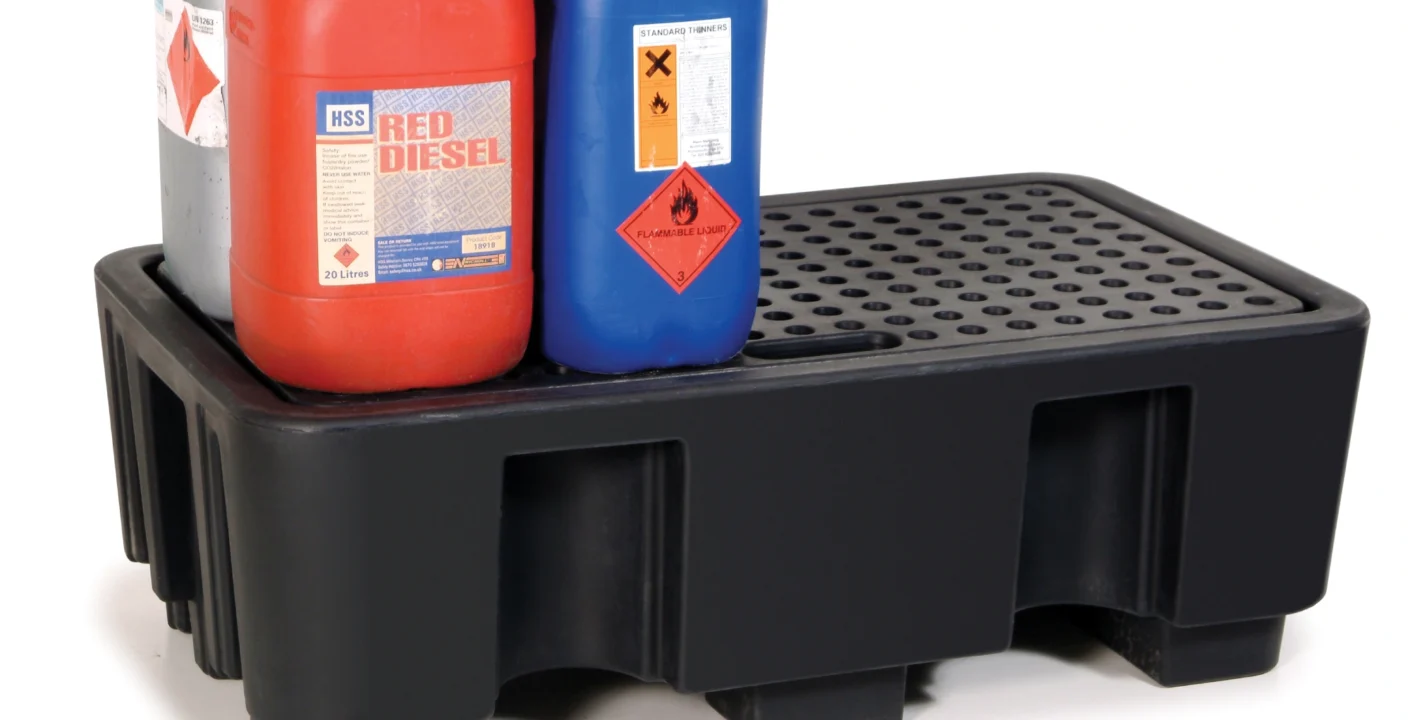
To understand hazardous material storage, you must categorise your containment methods. The container physically holding the liquid (such as a jerry can, IBC, or 205-litre drum) is your Primary Containment. The cabinet or bund that this container sits inside provides Secondary Containment.

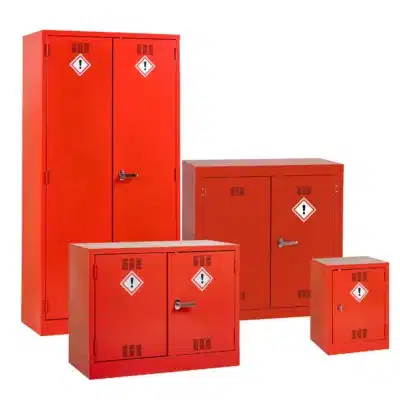
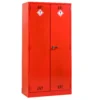
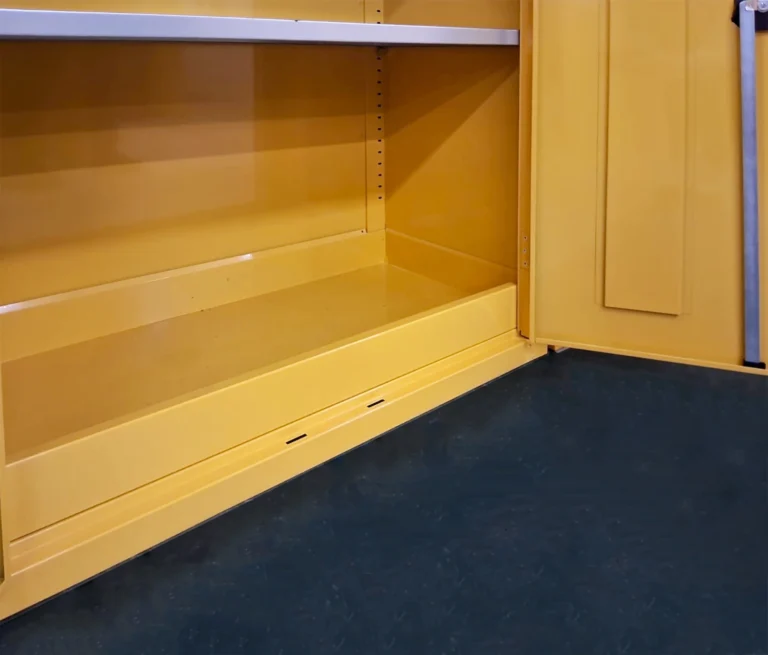
A sump is the leak-proof, fully welded reservoir built into the very base of a COSHH, Pesticide, or Flammable Storage cabinet. Unlike standard flat shelving, a compliant COSHH cabinet is engineered so that if a primary container splits, leaks, or overflows, the hazardous liquid flows safely down into this base tray.

The sump acts as your ultimate failsafe. It prevents toxic or flammable liquids from pooling on the warehouse floor, entering the site’s drainage system, or mixing with incompatible chemicals stored nearby.

Bundedstorage
Ibc & container sumps conformity

What a COSHH Sump is NOT: The Dangers of "DIY" Bunding

It is alarmingly common across the UK—particularly in agricultural farmyard storehouses or older industrial sites—to see facilities managers attempt to create their own makeshift “sumps.” This is often done by building a low breeze-block wall around a storage corner, or simply painting a section of a concrete floor with a heavy-duty sealant and calling it a bunded zone.

These manual, DIY areas are not compliant sumps. Here is why they fail HSE inspections:

  • Lack of Sealing: Concrete and brick are naturally porous. Without highly specialised, chemically resistant linings, corrosive liquids will eventually seep through the material and into the ground. Painted seals inevitably chip, crack, and degrade over time.

  • No Capacity Guarantee: These ad-hoc areas are rarely mathematically calculated to meet the strict 110% volume rule, nor are they formally tested for liquid retention.

  • Lack of Maintenance: Unlike a removable steel cabinet sump, a walled-off corner is incredibly difficult to clean and is rarely subjected to routine integrity inspections.

To put the importance of this into perspective: large-scale chemical storage warehouses are legally required to have entire sections of their flooring and racking facilities professionally bunded. These massive architectural bunds act as giant sumps, designed with strict preventative measures to stop catastrophic leaks from reaching site drainage systems, local wildlife habitats, and UK waterways.

The sump in your COSHH cabinet operates on the exact same legal and environmental principles, just on a localised scale. A makeshift wall of bricks simply will not pass an HSE audit, nor will it protect your local water table. A fully welded, factory-tested steel sump will.

Bunded warehouse green
Chemical bunded warehouse store

The Legal Framework: HSE, COSHH, and DSEAR Explained

To understand why sump capacity is heavily enforced, we must look at the official regulatory bodies and documentation governing UK workplaces. Your storage solutions must align with the following:

COSHH

These regulations require employers to prevent or reduce workers’ exposure to hazardous substances. Proper secondary containment is a legal requirement under COSHH to prevent accidental exposure to staff via spills or vapour releases.

Source: Control of Substances Hazardous to Health Regulations 2002

DSEAR

If the liquids you are storing are flammable, DSEAR applies. The law mandates that any spills or leaks must be contained and safely managed to prevent the formation of explosive atmospheres and mitigate fire risks.

Source: Dangerous Substances and Explosive Atmospheres Regulations 2002

HSE HSG51

This specific Health and Safety Executive guidance document explicitly outlines the structural requirements for spill retention. It advises that cabinets and bins must be designed to retain spills up to a specific volume, ensuring that leaks cannot escape the storage area.

Source: Storage of flammable liquids in containers

Environmental Protection

While originally drafted for oil storage, the UK Environment Agency’s guidelines on secondary containment have become the universal industrial standard for all hazardous liquids, dictating the precise percentages required for spill retention to prevent groundwater contamination.

Source: Storing oil at a home or business

The Golden Rule: Calculating the 110% and 25% Sump Capacity

When purchasing a COSHH cabinet, you cannot simply guess the required size or rely on visual approximations. UK environmental and safety best practices dictate that your secondary containment must be able to handle a worst-case scenario spill safely.

To be fully compliant, your cabinet’s sump must have a capacity capable of holding whichever of the following volumes is greater:

  1. The 110% Rule: The sump must be able to hold 110% of the volume of the largest single container stored within the cabinet. (The extra 10% accounts for sudden surges, sloshing, or debris that may already be in the sump).

  2. The 25% Rule: The sump must be able to hold 25% of the total combined volume of all containers stored within the cabinet.

Internal sump
Coshh cabinet - internal sump

Real-World Calculation Examples

Scenario A: Storing large individual containers

You are storing a single 25-litre drum of highly flammable solvent alongside a few small 1-litre tins.

  • 110% of the largest container: 25L x 1.10 = 27.5 Litres.

  • 25% of total volume (approx 28L): 28L x 0.25 = 7 Litres.

  • The Requirement: Because 27.5 Litres is the greater amount, your cabinet’s sump must have a minimum capacity of 27.5 Litres.

Scenario B: Storing multiple small containers

You are storing fifty 2-litre bottles of corrosive cleaning chemicals (100 Litres total).

  • 110% of the largest container: 2L x 1.10 = 2.2 Litres.

  • 25% of total volume: 100L x 0.25 = 25 Litres.

  • The Requirement: Because 25 Litres is the greater amount, your cabinet’s sump must have a minimum capacity of 25 Litres.

Standard Cabinet Sizes vs. Sump Capacities

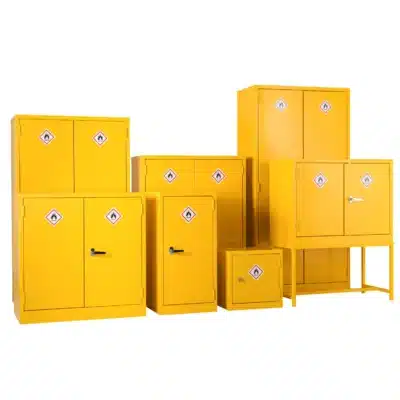
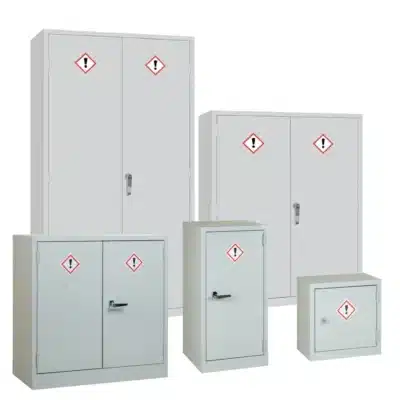
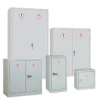
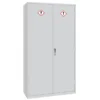
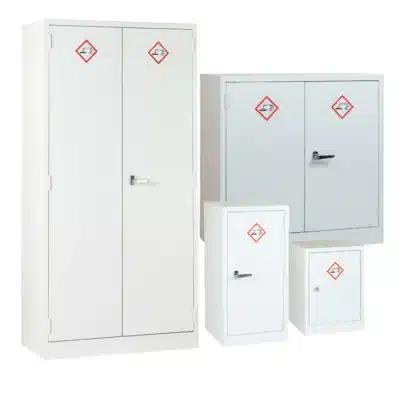
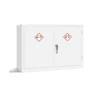
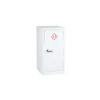
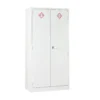
It is critical to match your inventory volume to the manufacturer’s certified sump specifications. Below is a reference guide based on our industry-leading Redditek Flammable Liquid Storage range. These units are fully welded from strong 20swg steel to meet stringent UK safety regulations.

Cabinet Configuration Dimensions (H x W x D) mm Shelves Included Sump Cap. (Ltrs) Lock Type SKU (G = Grey)
Floor Cabinet (Mini) 457 x 457 x 305 1 (Adjustable) 13.5 Lever Lock (2 Rods) FB1(G)
Floor Cabinet (Small) 610 x 457 x 457 1 (Adjustable) 14.5 FB4(G)
Floor Cabinet (Standard Single) 915 x 457 x 457 1 (Adjustable) 14.5 FB10(G)
Floor Cabinet (Low Wide) 712 x 915 x 457 1 (Adjustable) 27.0 FB15(G)
Floor Cabinet (Medium Wide) 915 x 915 x 457 1 (Adjustable) 27.0 FB20(G)
Floor Cabinet (Large Wide) 1220 x 915 x 457 2 (Adjustable) 27.0 FB25(G)
Floor Cabinet (Extra Large) 1525 x 915 x 457 3 (Adjustable) 27.0 FB26(G)
Floor Cabinet (Tall) 1830 x 915 x 457 3 (Adjustable) 27.0 FB30(G)
Floor Cabinet (Jumbo) 1800 x 1200 x 500 3 (Adjustable) 42.5 FB40(G)

What Happens During an HSE Inspection?

If an HSE inspector audits your site, they will cross-reference the volume of chemicals you are storing against the physical capacity of your cabinet’s sump.

If your sump is deemed too small for the volume of liquids stored, or if the sump is structurally compromised, the HSE can issue a Notice of Contravention (NoC). In severe cases involving highly flammable or highly toxic substances, they have the authority to issue an Improvement Notice or a Prohibition Notice. A Prohibition Notice legally halts your operations until the storage issue is rectified, and you will be subject to substantial “Fee for Intervention” (FFI) hourly charges for the inspector’s time.

The 5 Biggest Sump Maintenance & Operational Mistakes

Even with a premium, fully compliant cabinet, poor warehouse habits can immediately void your compliance. Ensure your site managers avoid these severe operational errors:

Storing items inside the sump tray

The sump is engineered strictly for emergency containment. If your staff place spare bottles, rags, or tools directly inside the sump, they are actively displacing its volume. It will no longer hold the legally required 110% spill, causing it to overflow instantly onto the floor during an accident.

Ignoring "phantom" leaks

If a minor leak occurs, the sump must be drained, cleaned, and neutralised immediately using a compliant spill kit. Leaving corrosive chemicals or flammable liquids sitting in a steel sump will degrade the metal over time, completely destroying the secondary containment.

Using incompatible absorbents

If a spill occurs in the sump, you must use the correct absorbent materials to clean it (e.g., chemical absorbents for acids, oil-only absorbents for hydrocarbons). Sweeping generic sawdust into a sump full of flammable liquid creates a massive fire hazard.

Mixing incompatible chemicals

A sump cannot separate liquids once they spill. If you mistakenly store reactive chemicals (like an acid and a flammable solvent) in the same cabinet and both leak, they will mix in the sump, potentially causing a violent exothermic reaction or a toxic gas release. Always segregate chemical classes into separate, colour-coded cabinets.

Failing to inspect removable sumps

Many high-quality cabinets feature fully removable sumps for easier cleaning. Facilities managers must ensure these are correctly re-seated after cleaning; an incorrectly placed sump will fail to catch liquids dropping from the shelves above.

Need Expert Advice on Hazardous Storage?

Ensuring your facility is fully compliant with HSE, COSHH, and DSEAR regulations doesn’t have to be a guessing game. At HSE Store, we supply a comprehensive range of British-manufactured COSHH and Flammable Storage cabinets engineered for absolute safety and longevity.

Whether you need a standard 27-litre sump cabinet or a high-capacity storage solution for bulk hazardous materials, our technical sales team is ready to ensure you get the exact specification your risk assessment requires.

View Our Full Range Here

COSHH Cabinets for all chemical types; Flammables, Corrosives, Hazardous & More
British Made
Leave a Reply
shopping cart close