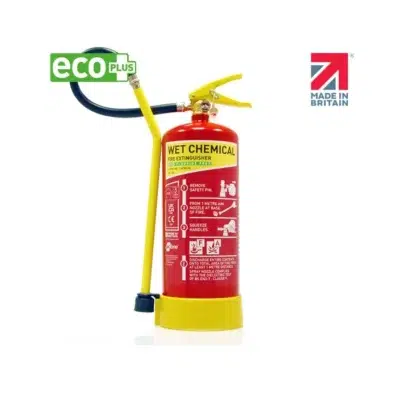
What is a wet chemical fire extinguisher?
A wet chemical (Class F) extinguisher holds an alkaline, usually potassium-based solution. On a fryer fire it:
- Cools the oil
- Reacts with the fat to form a soap-like blanket (saponification)
- Holds vapour down so the fire is less likely to re-ignite
That is why water is dangerous on a fryer and why foam or powder is the wrong kitchen first-aid tool. Water flashes the oil; powder contaminates food equipment; foam does not saponify at 75F level.
UK identification is a yellow handle and header on a red body.
What is it used for?
- Deep-fat fryers and high-temperature cooking oils
- Commercial ranges, bratt pans and fat fryers
- Hotel, restaurant, school, hospital and contract-catering kitchens
- Marine galleys that need MED Class F cover
It also carries a 13A rating, so it will deal with a Class A bin or packaging fire in the same kitchen. That is secondary. The reason it exists is Class F.
Who is it for?
Catering managers, facilities and H&S leads, school and healthcare estates, hotel groups, and vessel operators with a galley. If the fire risk assessment records a fryer, this is the portable that belongs on that point — not a 9L water unit and not water mist alone if the F rating of mist (25F / 40F) is too low for the vat size.
What problem does it solve?
Cooking oil above its auto-ignition point will re-flash if you only knock the flame down. Wet chemical cools and seals. It also avoids the steam explosion you get if someone puts a water jet into a vat. That is the practical kitchen problem this category exists to fix.
Types and specification
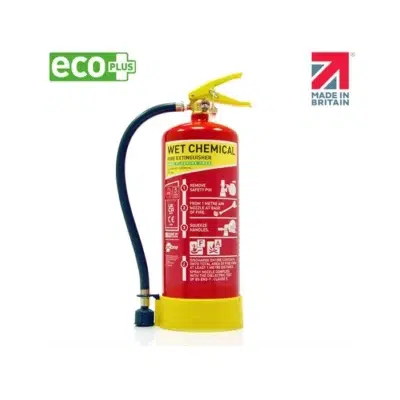
All four products are 6 litre Eco Plus, 13A | 75F.
| Model | Application | Typical use |
|---|---|---|
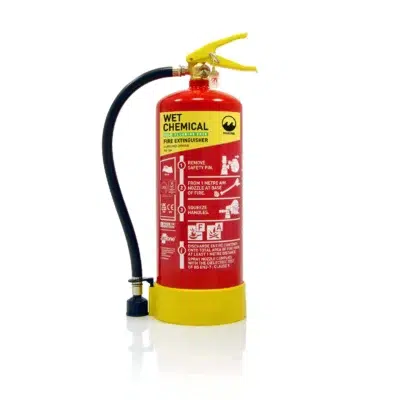
| Premium 6L with hose | Flexible hose | General kitchen plant, offset access |
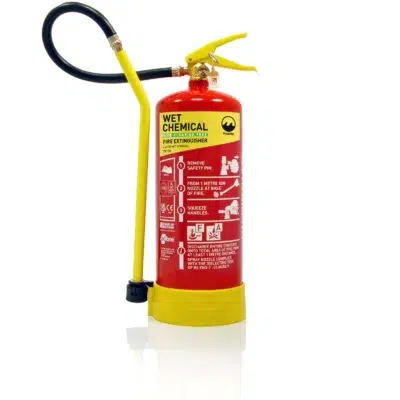
| Premium 6L with lance | Rigid lance | Fryer line — apply from 1 m without leaning over the vat |
| Marine 6L with hose | Hose + MED | Galley / vessel, SI 2016/1025 |
| Marine 6L with lance | Lance + MED | Galley fryers on MED vessels |
Published Premium figures:
- Fire rating 13A | 75F
- Discharge ~51.3 s
- Size 517 × 160 mm
- Filled ~11.08 kg / empty ~4.16 kg
- Pressure 8 bar at 20 °C (lower than the 15 bar foam/water/powder family)
- Temperature +5 °C to +60 °C
- Propellant: nitrogen
- LPCB and Kitemark to BS EN3, UKCA, CE
- Dielectric test BS EN3-7, Clause 9
- 5-year guarantee
Lance when the risk is a vat you must treat from a set stand-off. Hose when you need to work around islands and extract canopies. Marine when the vessel certificate requires MED, not only EN3.
How to use it — and what not to do
Turn off the heat if it is safe. Stand about a metre off, as the label requires. Apply gently onto the surface; do not punch a jet into the oil. Coat the whole area. Leave the crust in place until the oil is cool.
Do not:
- Use water, a water jet, or water mist as the fryer first attack if you have wet chemical available
- Use this as the site’s Class B (fuel/solvent) extinguisher — specify foam or powder for that
- Use it on lithium-ion batteries
- Store it below +5 °C
Service under BS 5306-3. After any discharge, refill or replace. Train kitchen staff specifically — a fryer fire is not a paper-bin fire.
Why buy wet chemical from HSE Store
HSE Store stocks the current Jactone Eco Plus 6L Class F family — PFAS-free, 13A | 75F, hose or lance, Premium or Marine MED. That matches what a commercial kitchen or galley actually needs, rather than a mist unit with a lower F rating or leftover AFFF chemistry.
Frequently asked questions
What fire classes does wet chemical cover?
Class F cooking oils and fats, plus Class A solids. These 6L Eco Plus units are rated 13A | 75F. They are not sold as Class B extinguishers.
Hose or lance?
Lance for a fryer you must treat from 1 metre with a controlled stream. Hose where you need to move around kitchen plant.
Is Eco Plus the same as old wet chemical?
Eco Plus is PFAS-free / fluorine-free. Same Class F job — saponify and cool — without persistent fluorochemicals.
Can I use it on electrical equipment?
The nozzle meets BS EN3-7 Clause 9. Isolate power if you can. The primary job is the fryer, not a switchboard — use CO2 there.
Will water mist replace this in a commercial kitchen?
Not on a serious fryer line. Water mist on this site is 25F (3L) or 40F (6L). Wet chemical is 75F. Keep wet chemical on the cook line.
Do Marine models use a different agent?
No. Same 6L Eco Plus Class F charge. Marine adds MED approval under SI 2016/1025 for galleys and offshore catering.