Fire Extinguishers for Commercial, Industrial & Workplace Fire Protection
Choosing the correct fire extinguisher is an important part of workplace fire safety. Different extinguishing agents are designed for different types of fire, so the right equipment depends on the materials, processes, machinery and hazards present within your premises.
At HSE Store, our fire extinguisher range is designed to cover a broad range of commercial, industrial, workplace, catering and marine applications. Our selection includes water, water mist, foam, ABC powder, CO₂ and wet chemical fire extinguishers, together with marine-certified models and specialist PVSTOP solar panel fire protection.
The range includes different capacities and specifications to suit different applications, from compact extinguishers for targeted protection through to larger-capacity models for demanding commercial and industrial environments. Many of our extinguishers are British manufactured, with selected models carrying BS EN 3 certification, Kitemark certification, UKCA and CE marking, or marine approval where applicable.
Types of Fire Extinguishers
Water Fire Extinguishers
Water fire extinguishers are primarily used against Class A fires, which involve ordinary combustible materials such as wood, paper, cardboard, textiles and many common workplace materials.
They are a familiar choice for offices, schools, warehouses, shops, storage areas and other premises where the principal fire risk comes from combustible solids. Water works by cooling the burning material and reducing the temperature below the point at which combustion can continue.
HSE Store supplies 6 litre and 9 litre water fire extinguishers across Premium, Prestige and Marine ranges. The current range includes British-made models suitable for both general workplace applications and specialist marine environments.
Water extinguishers should not be used on fires involving flammable liquids or live electrical equipment unless the specific extinguisher has been independently approved for that application. Always check the extinguisher label and fire rating before use.
Water Mist Fire Extinguishers
Water mist extinguishers use water discharged as a fine mist, providing a modern alternative to conventional water extinguishers where a more versatile extinguishing solution is required.
The very fine water droplets can provide rapid cooling while minimising the amount of water discharged, making water mist suitable for a range of workplace environments where lower residue and reduced clean-up are desirable.
Our range currently includes 3 litre and 6 litre water mist extinguishers in both Premium and Marine configurations. These models provide a practical option for commercial premises and specialist environments where a versatile water-based extinguisher is required.
As with any fire extinguisher, the specific fire ratings and approved applications vary between models. Always refer to the individual product certification and manufacturer's instructions when selecting equipment for a particular risk.
Foam Fire Extinguishers
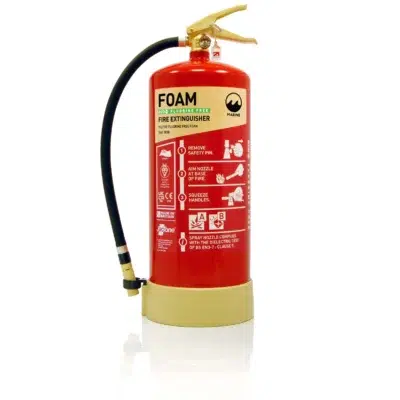
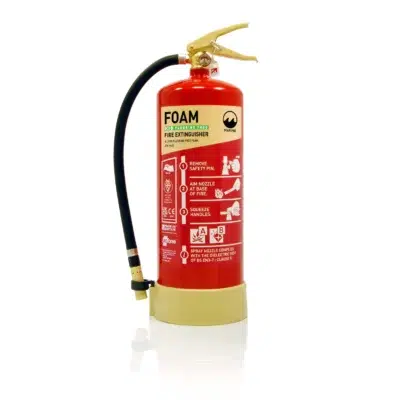
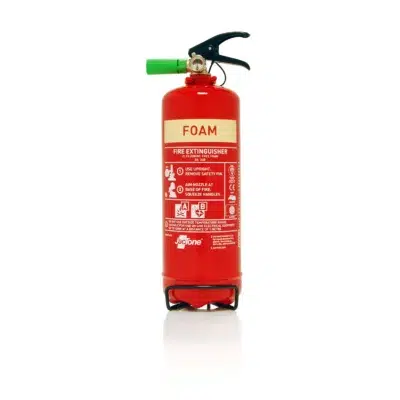
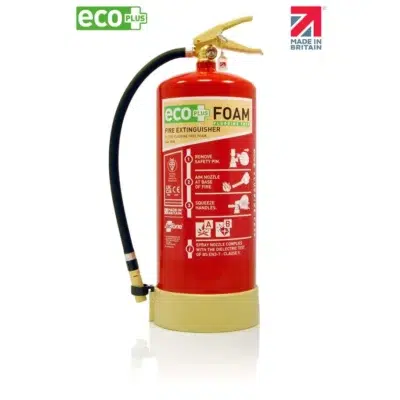
Foam fire extinguishers provide protection against Class A and Class B fire risks, covering both ordinary combustible materials and many flammable liquid hazards.
They are commonly specified for workshops, garages, warehouses, factories, commercial premises and industrial environments where there may be a mixture of solid combustibles and flammable liquids such as fuel, oils or similar products.
The foam forms a covering layer across the surface of a burning liquid, helping to suppress the flames and reduce the risk of re-ignition while also providing cooling.
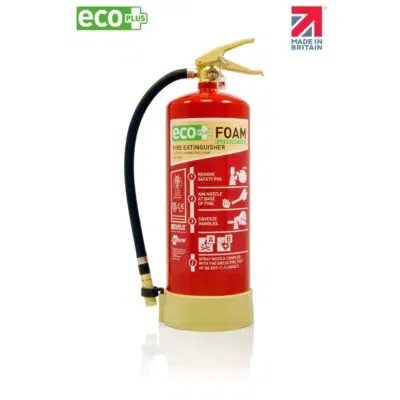
HSE Store's current range uses Eco Plus PFAS-free foam and includes 2 litre, 6 litre and 9 litre models across Basic, Premium and Marine ranges. The marine models provide an option where suitable marine certification is required, while the standard range provides solutions for general workplace applications.
Foam can be a useful choice where a workplace has mixed Class A and Class B risks, although the exact extinguisher provision should always reflect the site's fire risk assessment.
ABC Powder Fire Extinguishers
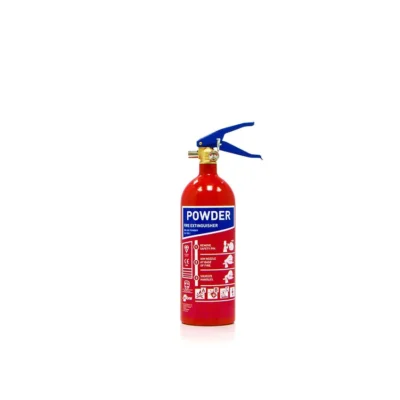
ABC powder fire extinguishers are a versatile option for a range of fire risks. They are designed for Class A, Class B and Class C fires, covering combustible solids, flammable liquids and flammable gases.
This broad range of applications makes ABC powder extinguishers particularly useful in workshops, garages, industrial premises, construction environments, plant areas and certain outdoor applications where a mixed fire risk may exist.
HSE Store currently supplies ABC powder extinguishers in 1kg, 2kg, 4kg, 6kg and 9kg capacities, including Basic, Premium and Marine models. The smaller Basic products are also available in multipacks, providing a practical option for customers purchasing multiple extinguishers for a fleet, site or group of locations.
Powder extinguishers can provide strong fire-fighting capability, but they are not automatically the best choice for every indoor environment. Discharged powder can significantly reduce visibility and create considerable residue, which can affect electrical equipment, machinery and surrounding areas.
For this reason, extinguisher selection should be based on the individual fire risk rather than simply choosing the extinguisher with the widest range of fire classes.
CO₂ Fire Extinguishers
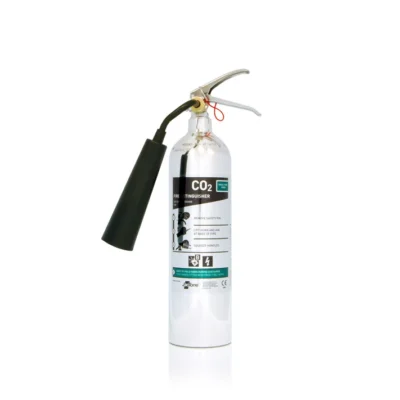
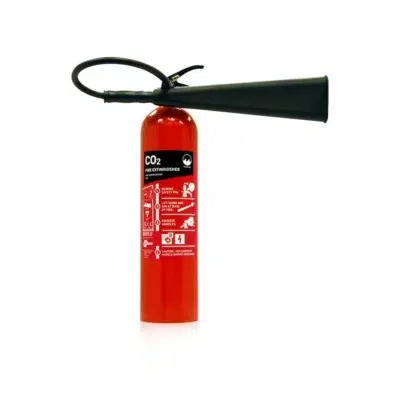
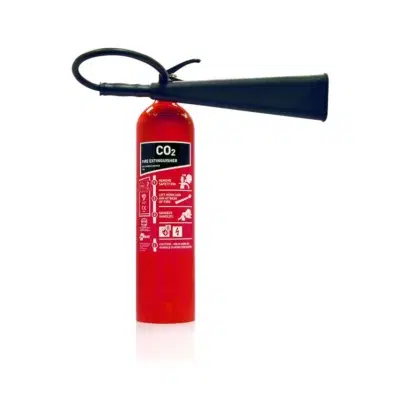
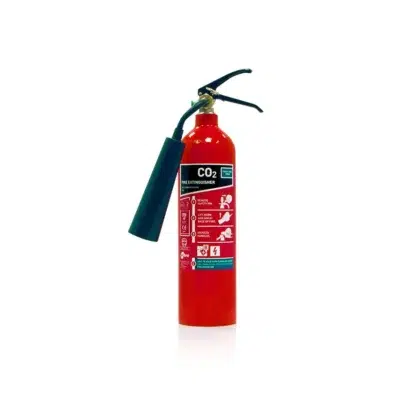
CO₂ fire extinguishers are commonly selected for electrical fire risks and Class B flammable liquid fires.
Carbon dioxide is a clean extinguishing medium that leaves no powder, foam or water residue after discharge. This makes CO₂ particularly useful in areas containing electrical equipment, machinery and other equipment where contamination or clean-up could present an additional problem.
Typical applications include offices, workshops, server and communications areas, electrical installations, control rooms, factories and commercial premises.
HSE Store supplies 2kg and 5kg CO₂ extinguishers, including Premium, Prestige and Marine models. Selected models feature frost-free horns or valves designed to provide reliable operation while handling the cooling effect associated with CO₂ discharge.
As with all extinguishers, electrical equipment should be isolated from the power supply where this can be done safely, and the extinguisher's specific instructions and fire ratings should be followed.
Wet Chemical Fire Extinguishers
Wet chemical fire extinguishers are specifically designed for Class F fires involving cooking oils and fats.
They are particularly important in commercial kitchens, restaurants, catering facilities, canteens, hotels, schools and other food-preparation environments where deep-fat fryers and cooking oils create a specialised fire risk.
A wet chemical extinguisher uses an agent that helps cool the burning cooking medium while creating a layer over the surface, helping to prevent the fire from re-igniting.
Our current wet chemical range consists of 6 litre models in Premium and Marine configurations, with options including a hose or lance depending on the model.
Wet chemical extinguishers should be selected where Class F hazards have been identified. Conventional water extinguishers are not appropriate for burning cooking oils and fats, as introducing water to hot oil can create a serious fire hazard.
Marine Certified Fire Extinguishers
Fire protection aboard vessels requires careful consideration of the particular environment, equipment and applicable marine regulations. An extinguisher intended for a marine application may need additional certification and approval beyond that required for a standard workplace extinguisher.
HSE Store supplies marine-certified fire extinguishers across several extinguishing media, including water, water mist, foam, ABC powder, CO₂ and wet chemical.
Our current marine range includes compact 2kg powder and CO₂ models through to larger 4kg, 5kg, 6kg and 9kg options, as well as marine water, water mist, foam and wet chemical extinguishers.
Selected marine models are approved under the Merchant Shipping (Marine Equipment) Regulations, alongside applicable British and European certification. For example, our Marine 6kg ABC Powder extinguisher is Kitemark certified to BS EN 3 and approved to the Merchant Shipping (Marine Equipment) Regulations SI 2016/1025.
Marine extinguishers can be suitable for commercial vessels, workboats and other maritime applications where appropriately certified equipment is required. Always confirm that the extinguisher selected is suitable for the vessel and specific location in which it will be installed.
PVSTOP Solar Panel Fire Protection
Solar photovoltaic systems create an additional consideration for fire and electrical safety because photovoltaic panels can continue generating electrical power while exposed to light.
HSE Store supplies PVSTOP Solar Panel Block Out in 4.5 litre and 9 litre formats. PVSTOP is a specialist solar PV fire-protection product rather than a conventional fire extinguisher.
The system works by applying a light-blocking coating to photovoltaic panels, helping to prevent the panels from continuing to generate electrical power. This makes it particularly relevant to solar installers, facilities managers, property owners and fire and rescue applications where photovoltaic systems present an additional electrical hazard.
The current HSE Store range includes 4.5 litre and 9 litre PVSTOP products for different installation sizes and coverage requirements.
For premises with rooftop solar panels, commercial PV arrays or larger solar installations, PVSTOP can form part of a wider fire-safety strategy alongside conventional firefighting equipment and appropriate electrical isolation procedures.
Understanding Fire Classes
Understanding fire classes is one of the most important steps when selecting a fire extinguisher. Different types of fire require different extinguishing methods, and using an unsuitable extinguisher can be ineffective or dangerous.
| Fire Class | Type of Fire | Typical Examples |
|---|---|---|
| Class A | Solid combustible materials | Wood, paper, cardboard and textiles |
| Class B | Flammable liquids | Petrol, diesel, oils, paints and solvents |
| Class C | Flammable gases | LPG, propane, butane and similar gases |
| Class D | Combustible metals | Specialist metal-processing and industrial risks |
| Class F | Cooking oils and fats | Deep-fat fryers and commercial cooking equipment |
| Electrical | Electrical equipment | Computers, machinery, control panels and appliances |
Electrical equipment is not classified as a separate UK fire class in the same way as Classes A, B, C, D and F. Instead, electrical risks require suitable firefighting equipment selected with the electrical hazard in mind.
The individual extinguisher label and certification should always be checked because the precise fire ratings and permitted applications vary between products. BSI's BS EN 3-7 standard covers the characteristics, performance requirements and test methods for portable fire extinguishers.
Which Fire Extinguisher Do I Need?
There is no single fire extinguisher that is suitable for every workplace. The correct selection depends on the hazards identified within the premises and the way the building or area is used.
Offices often present Class A risks from paper, furniture and other combustible materials, alongside electrical equipment such as computers, printers and office machinery. Water-based extinguishers may be suitable for the Class A risk, with CO₂ commonly used for appropriate electrical fire risks.
Warehouses can contain significant quantities of cardboard, packaging, plastics, stored goods and other combustible materials. Additional risks may exist where fuels, gases, chemicals or industrial equipment are present.
Workshops and garages can contain several different fire hazards at once, including combustible solids, oils, fuels, solvents, machinery and electrical equipment. The combination of risks should be considered when determining extinguisher provision.
Commercial kitchens require particular attention to Class F risks from cooking oils and fats. Wet chemical extinguishers are specifically designed for this type of fire and should form part of the firefighting arrangements where deep-fat frying or similar cooking processes are present.
Factories and plant areas may have more complex fire risks arising from machinery, processes, fuels, gases and electrical systems. Extinguisher selection should be based on the actual processes and materials present rather than the building type alone.
Marine environments require equipment suitable for the vessel and any applicable maritime certification requirements. Marine-certified versions are available across several extinguisher types within our range.
Fire Extinguisher Standards and Certification
Fire extinguishers used in commercial and workplace environments should be appropriately certified and selected as part of an overall fire-safety strategy.
BS EN 3-7 specifies characteristics, performance requirements and test methods for portable fire extinguishers. GOV.UK guidance states that new portable fire extinguishers should comply with BS EN 3-7.
The selection and positioning of portable fire extinguishers is covered by BS 5306-8:2023, which is the current BSI code of practice for the selection and positioning of portable fire extinguishers in buildings and premises.
The standard does not replace the need for a competent fire risk assessment. Instead, it provides guidance to help determine appropriate extinguisher types, locations and arrangements.
Depending on the product and application, additional certification may include Kitemark certification, UKCA marking, CE marking or marine approval.
How Many Fire Extinguishers Do I Need?
The number of fire extinguishers required depends on the size and layout of the premises, the types of fire risk present, the extinguisher ratings and the findings of the fire risk assessment.
There is therefore no universal number that can be applied to every building.
Government fire-safety guidance explains that responsible persons must ensure that firefighting equipment is appropriate for the premises and properly maintained. The equipment required will depend on the nature of the business and the risks identified.
For typical offices and shops, government guidance gives indicative provision based on floor area and travel distance, but larger or higher-risk premises may require different arrangements. The correct approach is to assess the individual building rather than relying on a simple extinguisher-per-square-metre calculation.
Extinguishers should also be readily accessible, clearly identified and positioned where they can be reached quickly without placing users at unnecessary risk.
Fire Extinguisher Colour Codes
Portable fire extinguishers use colour coding to help identify the extinguishing medium quickly.
The commonly recognised identification colours are:
- Water – red
- Foam – cream
- Powder – blue
- CO₂ – black
- Wet chemical – yellow
Modern extinguishers generally have predominantly red bodies, with the colour-coded panel or area identifying the extinguishing medium.
Colour coding is useful for quick identification, but it should not replace reading the extinguisher label. The fire rating, operating instructions and suitability for the hazard should always be checked before use.
Fire Extinguisher Maintenance and Inspection
Buying the correct fire extinguisher is only one part of effective fire protection. Extinguishers need to remain accessible, serviceable and correctly positioned throughout their working life.
Government guidance states that portable fire extinguishers require periodic inspection, maintenance and testing. Under normal conditions, routine checks should be carried out to make sure extinguishers remain serviceable, while maintenance by a competent person should generally be carried out annually.
Regular checks should identify obvious issues such as damage, obstruction, missing equipment or signs that an extinguisher has been discharged or tampered with.
Where an extinguisher is damaged, discharged or otherwise unsuitable, it should be dealt with promptly by a competent person.
Fire Extinguishers for UK Workplaces
Whether you are equipping a small office, warehouse, workshop, factory, commercial kitchen, vehicle, vessel or specialist installation, selecting the correct firefighting equipment is an important part of protecting people, property and business operations.
At HSE Store, our range has been selected to cover the most common commercial and industrial extinguisher requirements, with British-made options available across multiple extinguisher types, capacities and specifications.
From everyday Class A protection through to flammable-liquid, electrical, cooking-oil, mixed-risk and marine applications, selecting the right extinguisher starts with understanding the hazards present and matching the extinguishing medium to the fire risk.
For specialist environments or larger requirements, the correct equipment should always be determined in conjunction with the site's fire risk assessment and the relevant product certification.